The Quinfall: Ultimate Castle Siege, War Machines, and Territory Control Guide
Castles in The Quinfall are no longer mere scenic backdrops. Following the massive v1.4.0.2 update, they now serve as the primary economic engines of the continent, gathering trade fees from merchants and collecting gold rent from every personal altar across the province. If your guild fails to breach fortress gates or ignores strict server schedules, you will find yourself cast aside from realm politics, funneling your hard-earned wealth into another lord's treasury. Before stepping onto this unforgiving battlefield, brush up on core survival mechanics with our companion material, The Quinfall: Beginner's Guide. Below, we break down the brutal rules of territorial siege warfare.
Quick take: Castle Sieges in The Quinfall run twice weekly at fixed server times and last exactly 90 minutes. During battle, castle territories become forced open PvP zones across all server channels. Castle walls and gates take damage exclusively from basic attacks, explosive arrows (3x damage), and heavy siege engines. Any attempt to exploit throne defense via relogging triggers an immediate teleport back to town.
Geography of Power: Why Castle Ownership Matters
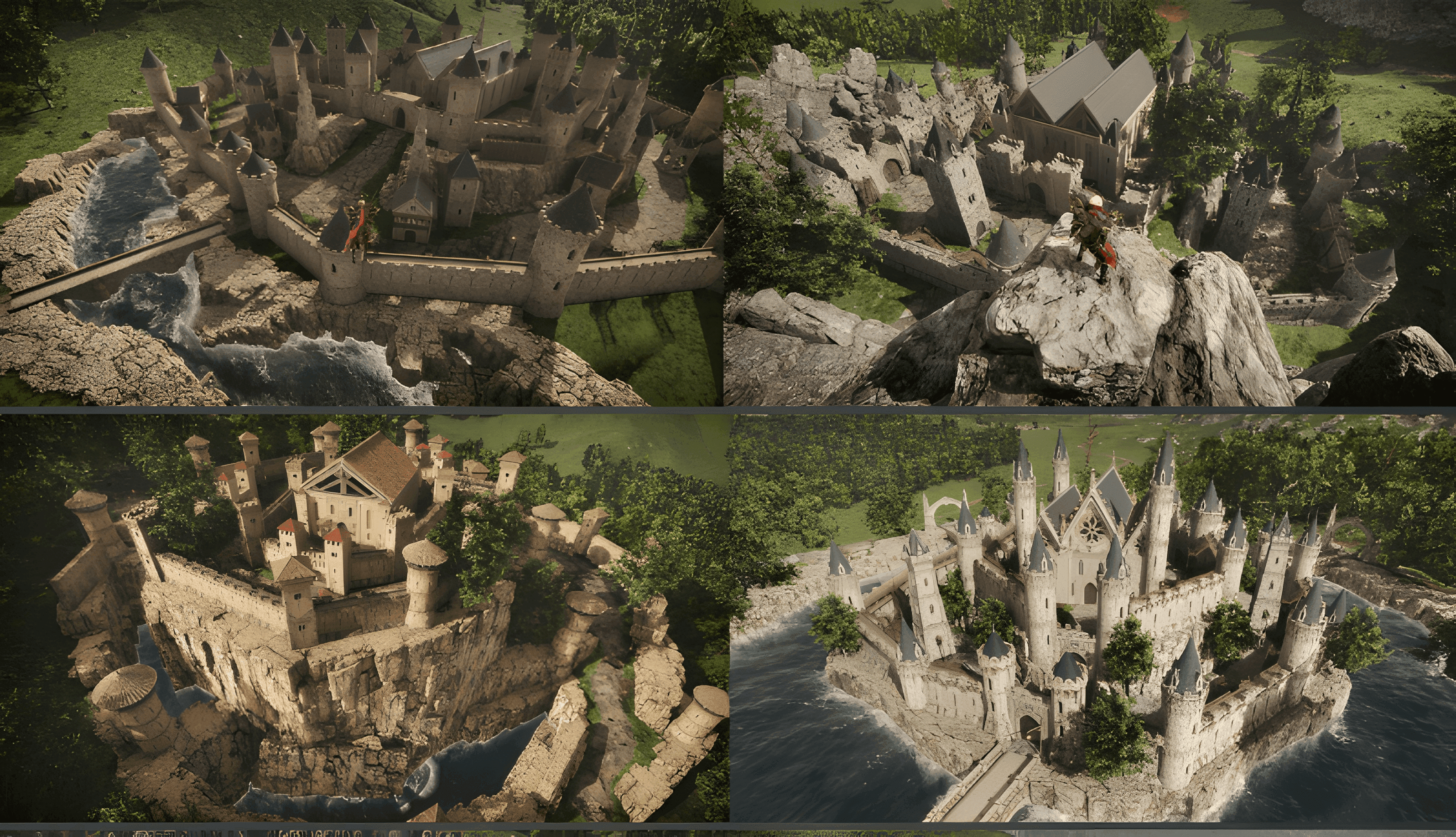
Every stronghold in the game anchors a distinct geographical biome, spanning sprawling provinces complete with outposts, trade arteries, and untamed wilds. Holding a castle awards a clan four decisive privileges:
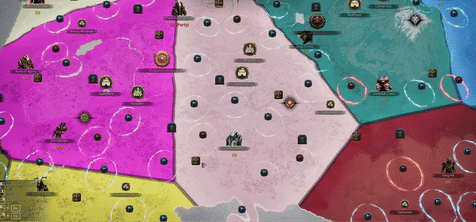
- Regional Sovereignty — The fortress flies your clan crest on the World Map, broadcasting your dominance over the province;
- Castle Gates Control — Massive iron gates permit passage exclusively to owning clan members, presenting an impenetrable barrier against unauthorized intruders;
- Castle Teleport — Instant recall for all clan members directly into the fortress courtyard via the dedicated clan interface;
- Castle Treasury — Automatic collection of regional taxes: sales at the Central Market, transactions with NPC vendors, and gold rent from all residential player altars.
In standard gameplay, many players dodge conflict by hopping to quieter channel mirrors. That safety net is gone here. Castle regions are designated open PvP zones on every single server channel. The moment you step into province borders, expect hostile patrols, ranged artillery, and ambushes. Keep your guard up.
Server Siege Timers: When War Horns Sound
The developers at Vawraek Technology removed offline night raiding entirely. Outside designated siege windows, castle walls, gates, and watchtowers are completely invulnerable. Structures can only be attacked during structured server events:
| Server Region | Siege Days | Start Time (Server Clock) | Battle Duration |
|---|---|---|---|
| Europe (EU) / Asia (ASIA) | Thursdays and Sundays | 21:00 | 90 minutes (ends at 22:30) |
| North America (NA) | Wednesdays and Sundays | 21:00 | 90 minutes (ends at 22:30) |
Siege combat lasts an intense hour and a half. Promptly at 21:00, the server announces wartime state across the realm, protective wards dissipate, and the fortress transitions into an active siege.
Good news for tournament fighters: update v1.4.0.2 completely separated competitive Olympiad Wars from the siege timetable. Olympiad duels now run every evening independently. Clan leadership no longer needs to divide top rosters between tournament ladders and gate defense.
Siege Lockdown: Fair Play and Security Rules
When battle starts, a strict Siege Lockdown protocol engages across the castle grounds. To shut down exploits and maintain competitive integrity, the server enforces five fundamental restrictions:
- Teleport Lockdown — The instant clan recall feature disables completely. Defenders must muster reinforcements on foot or on mounts through exterior approaches;
- Treasury Freeze — Transferring gold from the castle vault to clan vaults is forbidden during the battle window;
- Locked Tax Sliders — Rulers cannot tamper with tax rates while combat is underway;
- No Friendly Fire on Fortifications — The defending clan cannot damage its own gates, walls, or bastions;
- Throne Anti-Relog Protocol — Logging in or switching channels within 200 meters of the throne room immediately teleports your character to the nearest safe settlement. Camping offline inside the throne chamber is impossible.
At 22:30, the siege concludes. Every character (invaders and defenders alike) standing within a 400-meter radius of the castle is instantly evacuated to the nearest safe zone. Simultaneously, the server automatically repairs all breached walls, crushed battlements, and broken gates back to 100% durability, sealing the fortress under the rule of whoever claims the throne.
Engineering and the Tinkering Workbench: Crafting Siege Engines
Victory in The Quinfall siege warfare is decided long before war horns echo across the plains. Citadel stone walls and reinforced iron gates boast tremendous durability pools. Chipping away at them with ordinary broadswords or magic spells is an exercise in futility. The developers designed sieges around heavy artillery. If your clan intends to dominate the province, you will need a dedicated engineering corps and a steady supply chain of raw ore and refined ingots. To learn how to establish gathering outposts and basic metallurgy, consult our companion material, Gathering & Crafting Guide. Below, we examine military manufacturing at the war bench.
Quick take: Constructing siege engines requires the Engineering profession and a Tinkering Workbench. Building wheeled artillery (Cannons, Catapults, and Battering Rams) unlocks at Engineering Level 30, while colossal Golems demand Engineering Level 50. There are no shortcuts here. Each player can house up to 20 machines in personal storage and field up to 5 deployed engines simultaneously.
Profession Thresholds: From Wheeled Rams to Heavy Golems
Fielding heavy war machinery requires more than blueprints. Your guild needs seasoned crafters with high mastery in Engineering. The tech tree divides siege engines into two distinct crafting tiers:
| Siege Engine | Chassis Type | Required Engineering Level | Initial Fuel Tank on Craft |
|---|---|---|---|
| Cannon | Wheeled Artillery | Level 30 | Pre-fueled with 200 Fuel |
| Catapult | Wheeled Ballistics | Level 30 | Pre-fueled with 200 Fuel |
| Battering Ram | Heavy Wheeled Breaker | Level 30 | Pre-fueled with 200 Fuel |
| Defensive Golem | Walking Heavy Automaton | Level 50 | Pre-fueled with 200 Fuel |
| Offensive Golem | Walking Flamethrower Automaton | Level 50 | Pre-fueled with 200 Fuel |
Every newly crafted engine comes rolling off the assembly line with a full starter tank of 200 Fuel. You do not need to hunt down fuel barrels for an immediate maiden voyage.
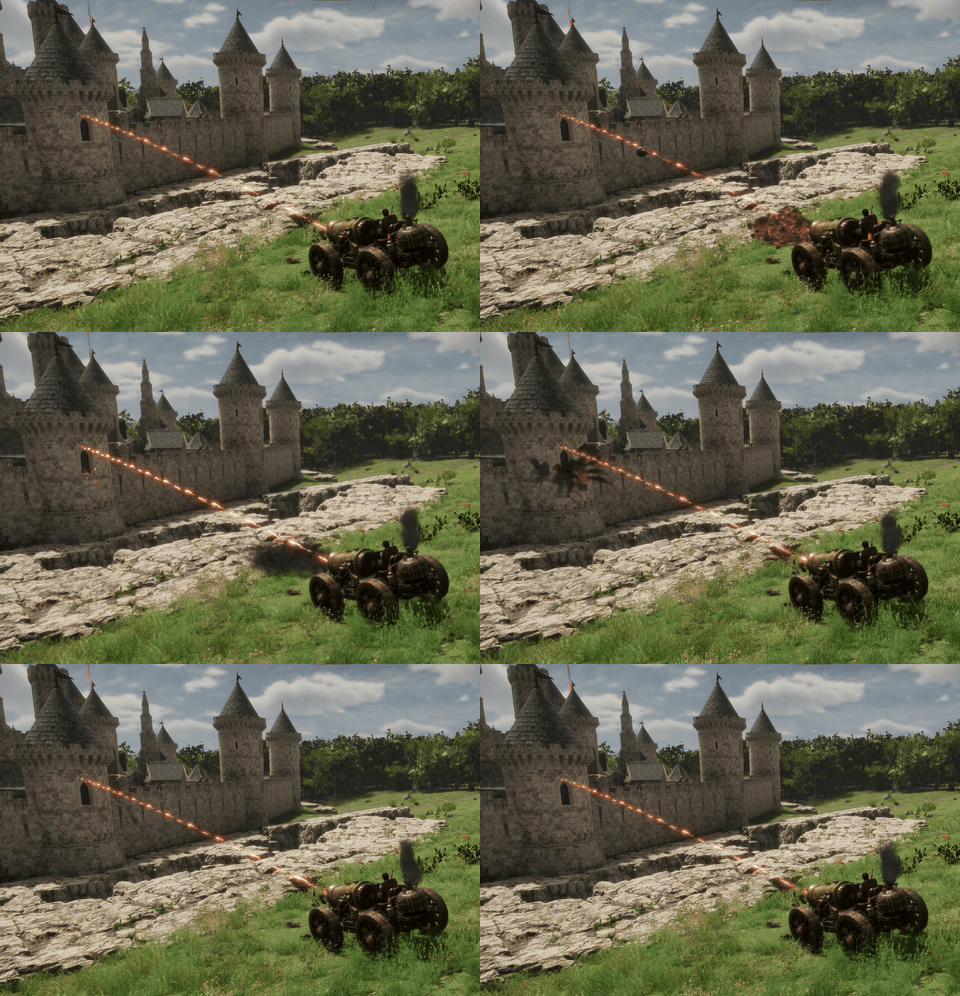
If your clan lacks high-level crafters with Level 50 Engineering, you can bypass the crafting grind entirely through player commerce. Open the Central Market and navigate to Placeable Items > Siege Vehicle. Fully assembled Cannons, Rams, and Golems can be purchased directly with gold from rival guilds or independent engineers.
The Tinkering Workbench: Ammunition, Fuel, and Parts
The specialized Tinkering Workbench is the beating heart of your war machine logistics. Beyond crafting bare frames, it handles all essential supplies:
- Fuel Synthesis — Crafted in batches of 5 units by combining fish oil (Fish Oil) and gunpowder (Gunpowder);
- Artillery Munitions — Foundry recipes for Cannon Balls and Catapult stones across three tiers of quality: Low, Medium, and High;
- Flamethrower Fuel (Flame Oil) — Highly volatile fuel oil tailored exclusively for the Offensive Golem's Flame Breath;
- Repair Parts — Field repair kits manufactured in packs of 5 units. Each repair kit instantly restores 10% of the engine's maximum HP.
Fleet Garage and Deployment Limits
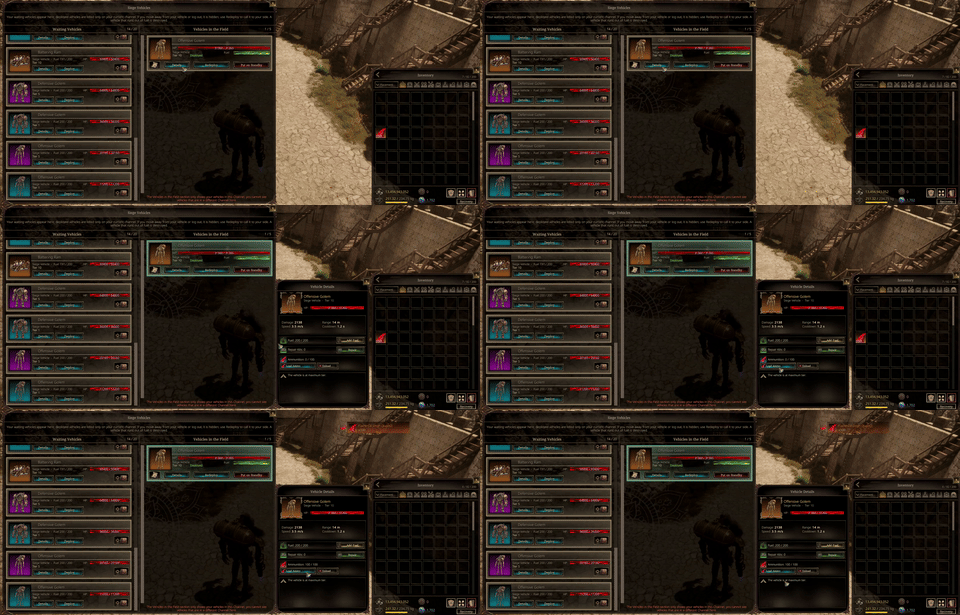
To prevent servers from choking on hundreds of abandoned war wagons, the game manages fleet limits through the dedicated Vehicles panel:
- Storage Capacity — A player can retain up to 20 siege engines safely stored in their garage reserve;
- Field Limit — You can have a maximum of 5 engines deployed in the world at the same time;
- Deploy Command — Places the selected war engine from your garage directly onto the ground in front of your character;
- Put on Standby — Recalls an idle engine back to your garage storage. Note that engines cannot enter standby mode if ammunition remains in the chamber; unload rounds first via the Details menu;
- Redeploy Command — Instantly summons a deployed machine to your side if it was temporarily hidden due to death or fast travel.
The Siege Arsenal: Cannons, Catapults, Rams, and Golems
Update v1.4.0.2 introduced a lineup of five specialized siege engines, each built to solve specific battlefield challenges. There is no single overpowered unit: heavy battering rams are vulnerable to flanking skirmishers, long-range artillery demands infantry escort, and towering war golems burn through rare reagents. Blending wheeled chassis with mechanical walkers dictates whether your assault shatters before the moat or breaches the inner sanctum in minutes.
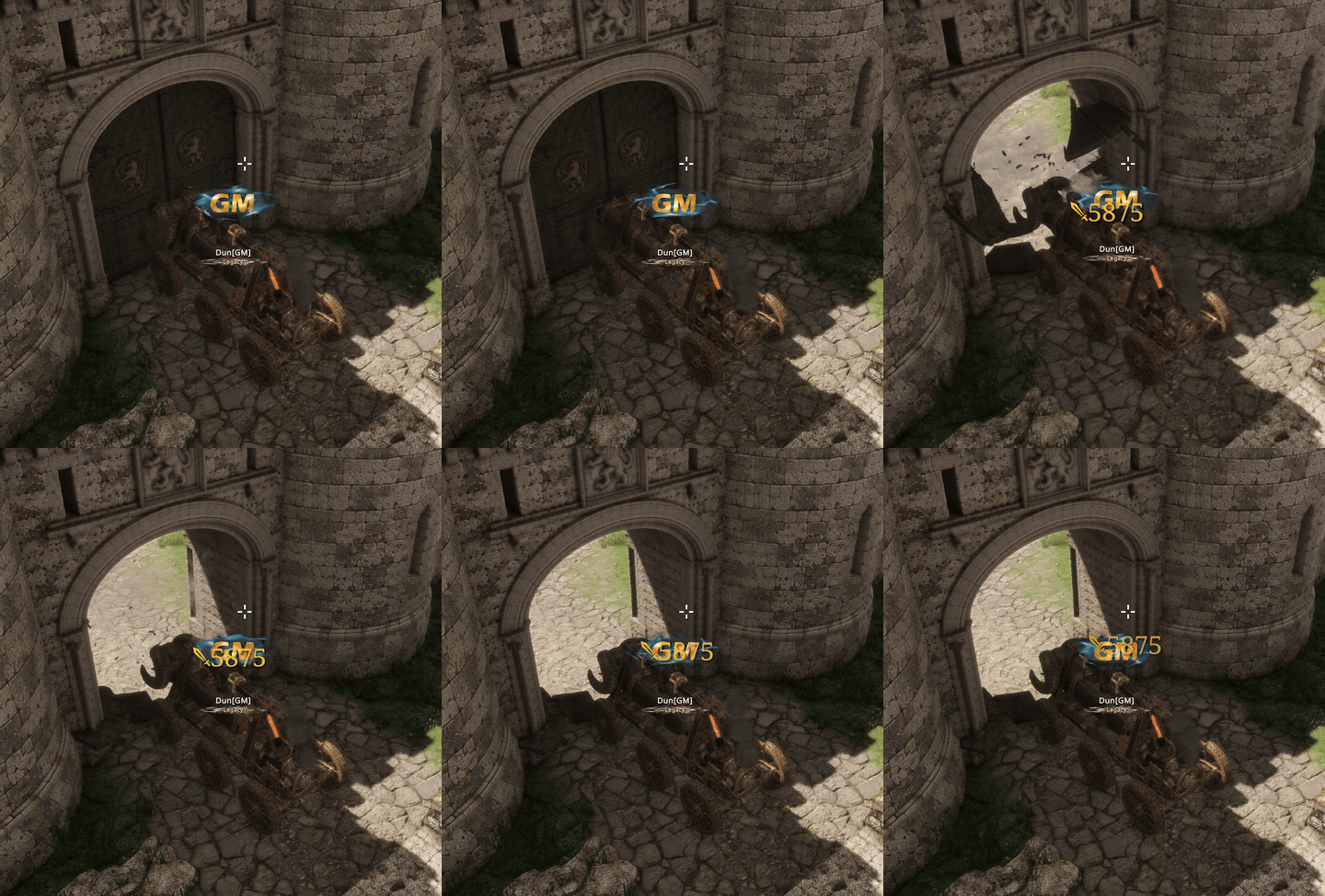
Quick take: The siege arsenal consists of three wheeled engines (Cannon, Catapult, Battering Ram) and two heavy walking Golems. Cannons and catapults hit out to 150 meters and deform the terrain, the battering ram boasts the highest HP among wheeled machines to crack gates, and golems serve as frontline battering shields. Crucially, while driving a siege engine, the pilot enjoys complete damage immunity — incoming fire is absorbed entirely by the machine hull. Forget personal shields.
Piloting and Driver Safety: The Iron Cocoon
Vehicle handling physics in The Quinfall prioritize tactical positioning and driver protection:
- Mounting and Dismounting — Approach your machine and hold E to take the driver seat. Exit at any time by pressing E or Esc;
- Exclusive Access — Only the registered owner can operate a siege engine. Enemy scouts or opportunistic looters cannot hijack an unattended machine;
- Absolute Driver Ward — While seated inside, your character takes zero damage from hostile arrows, blades, or spells. All incoming damage pools directly into machine hull durability;
- Handling Dynamics — Wheeled artillery can drive forward (W), reverse (S), and turn smoothly (A and D). Walking golems lack reverse gear; they turn directly on their central axis.
The Wheeled Triad: Cannon, Catapult, and Battering Ram
Crafted at Level 30 Engineering, wheeled platforms form the mobile artillery backbone of any clan assault:
A direct-fire artillery piece with an effective engagement range of 150 meters. Cannonballs travel on a flat, high-velocity trajectory, delivering massive concentrated impact damage to single targets. The Cannon damages players, hired workers (Workers), enemy siege engines, fortress walls, and altar bastions. Its internal magazine holds up to 100 Cannon Balls. Crucially, cannon blasts carve deep dynamic craters into the landscape, destabilizing enemy firing positions.
Unlike the flat-shooting cannon, the Catapult hurls heavy boulders in a steep, high-arching trajectory over a distance of 150 meters. It is the premier weapon for bombarding entrenched defenders behind stone crenellations. You can blanket archer parapets and flush out defenders from inner courtyards without needing direct line of sight. It holds up to 100 Catapult Ammunition rounds. Impacting boulders alter the terrain below, shattering defensive footholds.
A heavily armored close-quarters machine boasting the highest durability pool among all wheeled artillery. The Ram is engineered to batter down iron castle gates and breach outer stone curtains. It also deals heavy damage to hostile altars. Its major economic advantage: it consumes zero ammunition. It runs strictly on basic engine fuel. When gunpowder supplies run dry, Battering Rams keep the siege moving.
War Automata: Defensive and Offensive Golems
The pinnacle of Level 50 Engineering, these hulking automata fundamentally alter battle lines in tight chokepoints and gatehouse breaches:
| Combat Attribute | Defensive Golem | Offensive Golem |
|---|---|---|
| Tactical Role | Armored frontline shield, crowd suppression | Fortress breaker, area-denial flame assault |
| Primary Attack (Left Click) | Heavy punch against hostile siege engines and walls | Crushing fist strikes against structures and machines |
| Special Ability (Right Click) | Ground Slam: Shockwave dealing area damage to players, workers, and engines | Flame Breath: Broad frontal fire cone incinerating all targets |
| Ammunition Type | None required (Fuel only) | Flame Oil |
| Terrain Impact | Shatters ground around impact radius | Scorches and reshapes surface topography |
When charging the outer gates, march a Defensive Golem directly ahead of your Battering Ram. The golem draws defensive fire from parapet archers and ballistas, while its Ground Slam swats away flanking infantry attempting to deploy explosive charges on the ram's wheels.
Rules of Machine Survival: Fuel Timers, Field Repairs, and Upgrades
Constructing a fearsome siege engine is only half the battle. In The Quinfall, military vehicles require constant maintenance, disciplined logistics, and an uninterrupted fuel supply. The developers implemented strict rules governing physical presence and wear: an abandoned catapult will not linger in the grass indefinitely waiting for its owner. If you do not want to forfeit an expensive war machine worth hundreds of refined ingots to simple negligence, master the operational protocols and upgrade paths detailed below.
Quick take: Deployed machines constantly burn fuel: a full tank of 200 Fuel lasts exactly 24 hours, draining even when the machine is hidden. If fuel drops to zero, the machine is permanently destroyed. This is critical. Combat triggers a 60-second Combat Lock, preventing repairs or garage recalls. Engines upgrade from Tier 1 to Tier 10, transforming visually at Tiers 5 and 10 with Energy-Core Alloy.
The Ruthless Fuel Clock: Permanent Engine Death
The fuel mechanic is the most punishing system introduced in update v1.4.0.2. Unlike mounts or pets, siege engines do not forgive forgetfulness:
Commit this golden rule to memory: if your engine's fuel meter hits 0 units, the vehicle is permanently destroyed directly on the server. It cannot be salvaged with repair kits or restored by customer support. Fuel burns continuously from the moment you click "Deploy," even if the engine is temporarily hidden after a logout. A baseline reserve of 200 Fuel buys you precisely 24 hours of real-world time.
To sustain your war fleet, keep a dedicated fuel synthesis pipeline running at the Tinkering Workbench. Brewing a batch of 5 Fuel canisters requires two staple commodities:
- Fish Oil — Rendered from catches by guild anglers;
- Gunpowder — Refined by alchemists and mineralogists from coal and sulfur saltpeter.
Combat Damage, Field Repairs, and the Combat Lock
While siege engines feature hefty durability pools, crossfire from enemy cannons and focused infantry charges will rapidly deplete their armor. Field repairs adhere to strict combat limits:
- Repair Parts — Fabricated at the workbench in batches of 5 units or acquired as rare drops from world bosses. Each consumed repair part restores 10% of maximum HP;
- The 60-Second Combat Lock — The instant an engine inflicts or suffers any combat damage, a 60-second combat lock activates. During this minute, you are strictly barred from applying repairs, calling the vehicle via "Redeploy," or sending it to garage storage with "Put on Standby."
Proximity Rules and Hidden State Mechanics
The system governs unattended war engines with tight spatial and temporal rules, preventing players from stashing damaged artillery inside geometry mid-fight:
- 50-Meter Distance or Logout — If a pilot moves farther than 50 meters from their vehicle or logs out of the game, the machine remains physically anchored in the open world for 30 minutes. Any passing enemy detachment can destroy it uncontested;
- Transition to Hidden State — Once the 30-minute timer expires without owner intervention, the machine dematerializes into reserve storage;
- Pilot Death or Fast Travel — If the owner is slain in combat or uses a return stone, the engine vanishes from the map immediately, shielding it from execution;
- Recall to Service (Redeploy) — A hidden engine can be summoned directly to your feet at any time through the vehicle UI, provided you are standing outside restricted zones.
Restricted Deployment Zones
You cannot deploy an artillery battery in the middle of a town square or conceal a golem inside a private cabin. The game blocks the "Deploy" command in the following sectors:
- Within major cities, trade hamlets, shipping ports, and residential interiors;
- Within a radius of 450 meters from any hostile (red) player altar (Altar);
- Inside citadel throne rooms directly beside the castle throne.
Chassis Evolution: Upgrades from Tier 1 to Tier 10
War engines feature deep quality progression accessible through the vehicle's Details menu:
| Progression Tier | Required Materials | Features and Visual State |
|---|---|---|
| Tier 1 – Tier 4 | Basic metal ingots, lumber, basic chassis fittings | Standard factory model with steady baseline gains to HP and shell velocity |
| Tier 5 (First Metamorphosis) | Rare alloys, refined minerals, reinforced joints | Major visual transformation: Hull gains heavy plate barding and reinforced barrels |
| Tier 6 – Tier 9 | High-biome ores, thermal insulation plating | Maximum siege damage multipliers, faster cycle rates, elevated blast resistance |
| Tier 10 (Apex Mastery) | Energy-Core Alloy + bespoke machine components | Final metamorphosis: Glowing power conduits, maximum armor plating, and intimidating warframe |
When the siege ends and you prepare to stash your artillery in garage storage via "Put on Standby," the game will reject the command if rounds remain loaded. Open the Details menu, manually unload leftover cannonballs or flame fuel into your character inventory, and then confirm standby storage.
Assault Tactics: Breaching Fortifications and the Throne Battle
A castle siege in The Quinfall is not a chaotic brawl on a drawbridge. It is a highly structured, multi-phase military engagement. Coordinated artillery fire, suppressing parapet archers, and cool-headed position defense in the throne room carry equal weight. To ensure your battle roster is dialed in for brutal close-quarters clashes on spiral staircases, review our companion analysis, Weapons and Combat Builds Guide. Below, we break down the operational mechanics of the assault and the battle for the crown.
Quick take: Castle walls and gates are completely immune to character combat abilities. Damage is dealt solely through basic attacks, explosive arrows (3x damage), and siege artillery. To conquer a fortress, a clan member must hold the Throne alive and uninterrupted for 10 minutes. When the 90-minute battle concludes, all players within a 400-meter radius are evacuated to safety, and all fortifications instantly restore to 100% durability. The numbers do not lie.
Phase 1: Outer Wall Breaching and Fortification Vulnerabilities
Unlike conventional MMORPGs where raid groups melt gatehouses with area-of-effect spells, The Quinfall applies a rigid physical siege model:
- Ability Immunity — Class spells, stances, and active combat skills deal zero damage to stone curtains and iron gates. Wasting mana and cooldowns on stone is pointless;
- Basic Auto-Attacks — Standard melee swings and basic arrows inflict minimal chip damage, useful only for finishing off fractured wall segments;
- Explosive Arrows — Specialized munitions for ranged archers boasting a massive 3x damage multiplier against fortifications. An organized archer wing firing volleys of explosive arrows can methodically dismantle corner bastions under shield cover;
- Siege Engines — The cornerstone of destruction. Focused fire from paired cannons or continuous ramming breaks stone sections ten times faster than any infantry battalion.
Defending clan members cannot damage their own fortress walls, gates, or ramparts. This prevents internal sabotage by rogue members and shields structures from accidental artillery blasts during chaotic courtyard skirmishes.
Phase 2: Courtyard Assault and Chokepoint Pushes
The instant the outer gates shatter or a stone curtain collapses, combat shifts into close-quarters urban warfare. Defenders retreat to inner galleries and the central keep:
- Deploy Heavy Golems — March Defensive Golems through the breach first to soak up initial crowd control and defensive focus fire;
- Clear Elevated Firing Nests with Catapults — Use arcing catapult stones to bombard archers and healers entrenched on high parapets;
- Incinerate Chokepoints with Offensive Golems — Unleash Flame Breath down narrow corridors leading to the throne room to wipe out defense lines;
- Establish Containment Lines — Post frontline guards at stairwells and archways, cutting off defenders from reinforcement routes.
Phase 3: The Throne Room and 10 Minutes of Pure Hell
The ultimate prize of the entire siege is the Castle Throne, elevated on a dais at the far end of the great hall:
| Siege Mechanism | Trigger Conditions and Rules | Tactical Impact on Guild Operations |
|---|---|---|
| Hold Timer | A clan member must mount the throne and stay alive continuously for 10 minutes | If the throne occupant is slain even one second before the timer expires, the counter resets back to zero |
| Instant Ownership Shift | The moment the 10-minute timer finishes, the castle transfers immediately | The fortress recolors on the World Map, and castle gates instantly re-align to allied passage |
| Dynamic Power Swings | The throne can flip hands unlimited times until the overall siege clock runs out | The moment you capture the throne, your forces must pivot instantly from assault to turtle defense |
| Ambush Anti-Exploit | Logging into the server within 200 meters of the throne is strictly prohibited | Stashing an offline ambush squad inside the throne room prior to battle teleports them out to town |
Never seat your guild master or a glass-cannon DPS on the throne. Assign your guild's most heavily armored tank, fully buffed with damage mitigation, shields, and persistent regeneration from dedicated healers. Form a tight perimeter around the throne with crowd-control specialists to intercept stealth flankers.
The 90-Minute Finale: Instant Fortress Regeneration
At 22:30, the final war horn sounds, concluding the siege window:
- Victory Lockdown — The clan whose champion occupies the throne at the moment the 90-minute clock strikes zero claims undisputed ownership;
- Perimeter Sweep — Every character within a 400-meter radius of the fortress is instantly evacuated to the nearest neutral safe zone, putting an end to post-battle griefing;
- Automatic Wall Restoration — The game engine instantly restores all breached walls, collapsed battlements, and broken gatehouses to 100% durability free of charge.
Castle Ownership: The Treasury, Regional Taxes, and the Altar Rework
Claiming a castle is a momentous military victory, but the real test of a guild begins the following morning when war horns fall silent and economics take over. In patch v1.4.0.2, the developers of The Quinfall intertwined castle sovereignty with a sweeping overhaul of private real estate. Whereas landowners previously operated in an isolated vacuum, every resident in the province now indirectly pays tribute to their feudal lord. To understand site selection and private boundary rules, refer to our companion analysis, Housing & Altar Placement Guide. Below, we examine the machinery of territorial taxation.
Quick take: Holding a castle unlocks the regional Castle Treasury, which absorbs sales taxes from NPC vendors, cuts from the Central Market, and gold rent from all residential bases. In update v1.4.0.2, the altar upkeep model was completely redesigned: instead of dumping endless logs and stones into altars, players now pay recurring gold Rent scaled directly by the ruling castle's tax slider. Mismanage your rates, and your treasury stays barren.
The Lord's Toolkit: Teleportation, Gate Security, and Vaults
The clan holding a citadel controls province administration through the dedicated "Castles" tab in the guild interface:
- Castle Teleport — Any clan member can instantly recall directly into the fortress courtyard from anywhere in the world with a single click. This enables rapid garrison mobilization whenever threats arise across the province (the feature disables during active sieges);
- Secure Perimeter (Castle Gates) — Massive fortress gates swing open exclusively for allied clan members. Rivals, neutrals, and merchant convoys cannot enter unless gates are deliberately thrown open;
- Castle Treasury — A dedicated financial reserve that passively accumulates regional tax revenue. Transferring gold from the castle treasury to the main clan bank is reserved for the guild master and designated high-ranking officers.
Provincial Fiscal Levers: Where the Gold Flows
The ruling guild council can configure three independent fiscal rates spanning their entire geographical jurisdiction:
| Tax Category | Taxed Economic Activity | Impact on the Provincial Economy |
|---|---|---|
| NPC Trade Tax | Purchases and sales of gear, potions, and tools through town vendor NPCs | Provides steady daily baseline revenue, but extortionate rates drive new players to neighboring regions |
| Central Market Tax | Commission cut taken from every completed player transaction at regional market boards | The primary goldmine of major trade hubs: bustling commercial capitals generate staggering fortunes |
| Altar Tax | A percentage surcharge applied to the recurring gold rent of all private land plots | A direct tool to manage zoning density: aggressive rates clear out rivals and unaffiliated settlers |
Setting maximum tax brackets offers quick short-term gold, but inevitably ruins the local economy over time. Settlers pack up their workshops, traders detour around your cities, the treasury starves, and rival alliances mobilize to liberate the province. Moderate taxation attracts independent artisans, crafting collectives, and merchant caravans, multiplying your gross tax turnover.
The Great Altar Rework: From Raw Materials to Gold Rent
A persistent flaw of early game versions was the proliferation of "ghost" altars left behind by inactive accounts: servers grew choked with abandoned palisades, while feeding raw logs and stone slabs to ward off decay produced severe timing desync bugs. In patch v1.4.0.2, the developers overhauled the system:
- Raw Material Demands Removed — Altars no longer require regular deliveries of lumber, raw ore, or fiber to sustain their protective boundaries;
- Gold Rent Introduced — Altars now pay recurring rent strictly in gold. The fee scales dynamically based on structural volume, placed workbenches, and storage containers, multiplied by the ruling castle's Altar Tax;
- Automatic Legacy Conversion — Any crafting materials loaded into altars prior to the update were converted into credited rental time, populating the balance sheet of each existing plot;
- Automated World Cleansing — When a player stops depositing gold rent, the altar loses ward protection, allowing the engine to recycle the plot and free up fertile land for active builders.
A castle in The Quinfall is far more than an arena for weekend PvP. It is the administrative capital of the province, directly dictating the cost of living, crafting, and building for every traveler in the realm.
FAQ and the Top 5 Fatal Siege Mistakes
Castle warfare and territorial control in The Quinfall offer zero room for error. A single logistical oversight can erase hundreds of rare alloy ingots, waste weeks of guild preparation, and forfeit control of a lucrative provincial treasury. In this final chapter, we answer the community's most pressing questions, analyze the five critical mistakes that crush fledgling siege forces, and provide an operational checklist to ensure your guild takes the field fully prepared.
Quick take: The deadliest threats to your siege corps rarely stem from enemy blades; they arise from system timers. An unmonitored fuel tank permanently destroys war machinery, the 60-second Combat Lock blocks panic repairs, and trying to stage an offline throne room ambush triggers an automatic teleport to town. Tested and proven in live combat.
Frequently Asked Questions (FAQ)
What happens to my siege engine if it runs out of fuel?
The engine is permanently destroyed by the server. There is no recovery or inactive state: the instant your Fuel meter hits 0 units, the vehicle is deleted from the world database, even if it was resting in hidden reserve. Always maintain adequate reserves based on the standard burn rate of 200 Fuel per 24 hours.
Can player combat spells or weapon skills damage castle walls?
No. Citadel fortifications possess complete immunity to active character skills and spells. Damage can only be dealt by basic auto-attacks, specialized Explosive Arrows boasting a 3x damage multiplier, and heavy siege machinery (Battering Rams, Cannons, Catapults, and Golems).
Why does the game prevent me from deploying a catapult near an enemy outpost?
A strict spatial security boundary is hardcoded into the terrain: siege engines cannot be deployed within 450 meters of any hostile (red) player altar. To bombard a fortified camp, deploy your artillery outside the security perimeter and drive the machines into firing range under their own power.
What happens if our throne occupant disconnects during the 10-minute capture channel?
The capture timer cancels immediately and resets to zero. On top of that, the server's anti-exploit protocol engages: upon reconnecting, the character will not spawn in the throne room, but at the town square of the nearest settlement, because logging in within 200 meters of the throne during a siege is forbidden.
Do defenders need to spend gold to rebuild destroyed castle walls after the siege concludes?
No. The game engine handles all structural reconstruction automatically. At the exact moment the 90-minute battle window expires, all collapsed walls, flattened gatehouses, and shattered parapets restore to 100% maximum durability at zero cost.
The Top 5 Fatal Mistakes in Siege Warfare
Many guilds suffer catastrophic defeat before their vanguard even reaches the castle ditch. Here are the five most common blunders made by inexperienced commanders:
Crafters forge a premier Tier 5 golem or cannon, deploy it in an open field for a quick test drive, and then log off for the weekend without refueling or parking it. Deployed machines burn fuel every single minute, even while hidden. One day later, you log back in to find a prized siege investment permanently wiped from your account.
When an artillery battery gets targeted by enemy cannons, panicked drivers spam "Put on Standby" or attempt rapid field repairs with Repair Parts. Because of the 60-second Combat Lock, all maintenance commands are locked. The only way to save the machine is to throw it in reverse, duck behind ridge cover, wait out the full minute out of combat, and only then apply repairs.
Before a strategic retreat, the commander orders machines recalled to garage storage, but the vehicles refuse to despawn. The culprit is simple: shells remain chambered. An engine cannot be stashed while ammunition is loaded. Drivers must open the Details menu and manually unload all remaining cannonballs or flame oil into their inventory first.
Attempting to sneak an infiltration squad into an empty castle thirty minutes prior to war and logging out beside the throne dais is doomed to fail. The server enforces a 200-meter exclusion zone: when the siege starts or when players reconnect, all intruders are instantly expelled to the nearest village.
Young clans that capture a fortress often crank both Altar Tax and Central Market Tax to the maximum limit in hopes of becoming overnight millionaires. The outcome is predictable: landowners abandon their plots, merchants redirect trade caravans to neighboring provinces, the treasury empties out, and an overwhelming server coalition marches on your walls during the next siege window.
Clan Siege Readiness Checklist
Distribute this operational checklist across your officer channels three hours prior to the war horn:
- Fuel Logistics — Stockpile a minimum of 1,000 Fuel units (fish oil and gunpowder blends) distributed across officer bags;
- Artillery Munitions — Forge at least 100 High-grade shells per cannon and catapult, plus an ample stockpile of Flame Oil for vanguard golems;
- Field Repair Kits — Issue every driver at least 20 Repair Parts for emergency armor patching;
- Archer Wing Outfitting — Equip all sharpshooters with bundles of Explosive Arrows for concentrated structure demolition;
- Dedicated Throne Anchor — Designate a primary survivability tank and assign two dedicated pocket healers for the uninterrupted 10-minute hold.