 F2P · Live
Lineage 2 Essence
Lineage 2 Essence is NCSoft's free-to-play take on the classic Korean MMORPG Lineage II, built around faster…
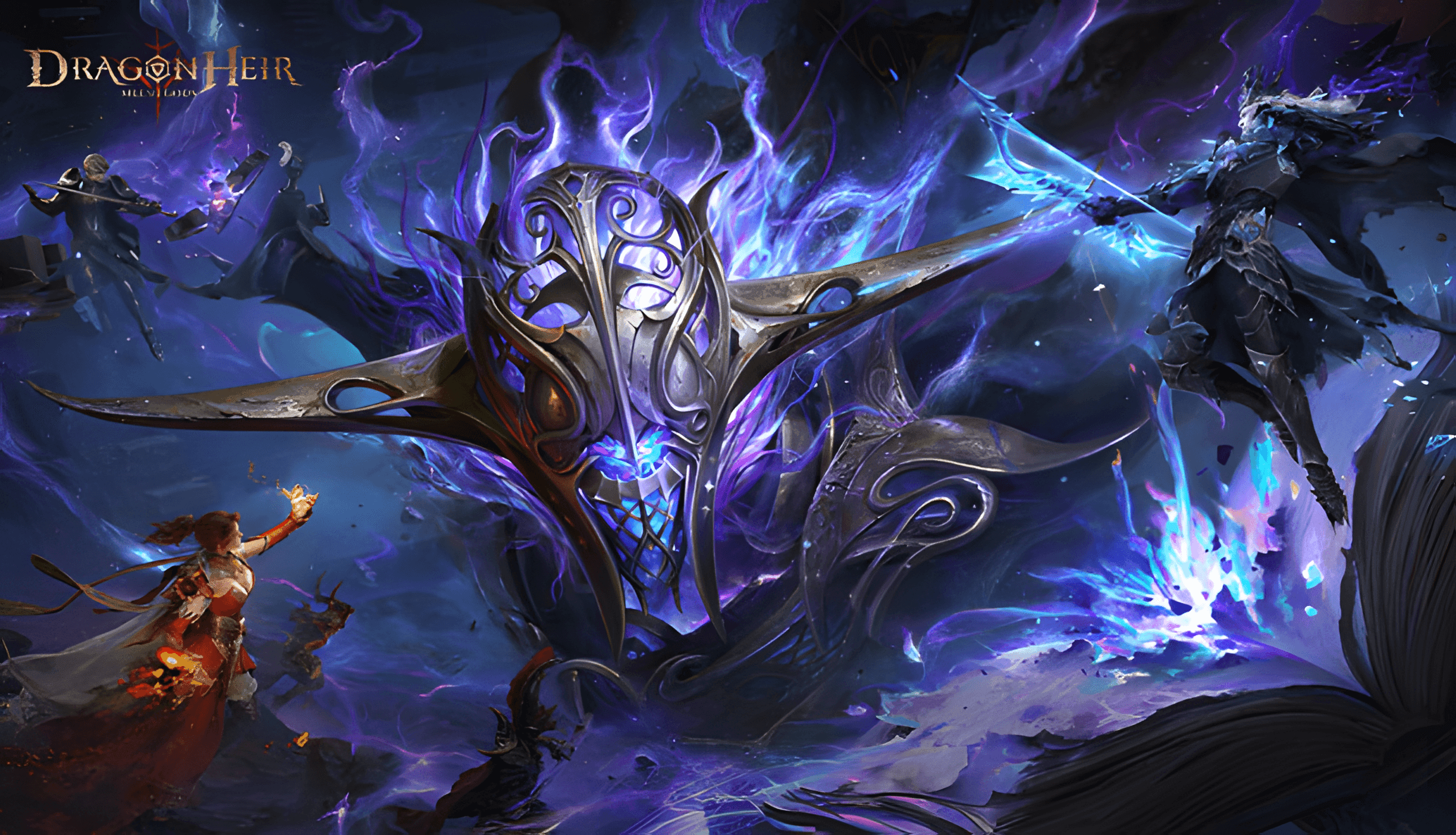
A tactical cross-platform role-playing game developed by SGRA Studio and published by Nuverse, seamlessly blending the atmosphere of classic isometric cRPGs with hero-collector mechanics and three-mon...
Quick take:Dragonheir: Silent Gods is an ambitious tactical party-based cRPG and hero-collector hybrid from SGRA Studio and Nuverse. Shattering the sterile conventions of menu-driven mobile battlers, the game delivers a fully native PC client, an authentic Dungeons & Dragons collaboration, and genuine tabletop D20 dice checks governing dialogue, sleight-of-hand pickpocketing, and combat abilities. It pairs the nostalgic warmth of old-school isometric adventure with the relentless pace of a live-service quarterly seasonal reset league, rewarding strategic foresight and positioning over brute-force spending.
For years, the hero-collector subgenre remained trapped in a formulaic loop: glossy menus, flat interface corridors, and automated skirmishes stripped of tactical nuance. Dragonheir: Silent Gods shattered that monotony by staging an audacious gamble. Developers at SGRA Studio set out to graft the narrative DNA of classic isometric computer RPGs—the spirit that once defined Baldur's Gate and Pillars of Eternity—onto the high-stakes framework of a seasonal live-service battler.
For desktop enthusiasts, the foremost question when examining the game's lavish art style is immediate: is this a genuine PC game, or merely a mobile title running inside an emulator wrapper? The answer is reassuringly definitive. Dragonheir: Silent Gods was conceived from its earliest development cycles as a true cross-platform ecosystem. Alongside its presence on mobile storefronts, it boasts a native Windows client available via Steam and a standalone launcher, as well as a native macOS build tailored for Apple Silicon processors.
The desktop experience is free of mobile compromises. Rather than emulating touch gestures, the PC build features tailored mouse-and-keyboard keybindings for rapid skill queuing, fully scalable 21:9 ultrawide resolution support, and an uncapped frame rate that runs at a silky-smooth 120 FPS. Enhanced texture packs, volumetric fog, dynamic global illumination, and crisp shadow maps powered by the Unity engine transform the continent of Adenthia into a living, breathing dark fantasy diorama on large desktop displays. Crucially, the game supports seamless cross-play and cross-progression: players can delve into demanding story dungeons from their gaming rigs at home and effortlessly tend to routine resource expeditions on mobile devices on the go.
The game's tabletop legitimacy is reinforced by an official partnership with Wizards of the Coast, integrating the legendary lore of Dungeons & Dragons directly into the game's world. This is no hollow cosmetic crossover. Renowned dark elf ranger Drizzt Do'Urden alongside his astral panther Guenhwyvar, the venerable archmage Elminster Aumar, the formidable wizard Bigby, and the demonic balor lord Errtu enter the narrative as fully fleshed-out participants. They arrive complete with dedicated story arcs, customized instanced dungeons, bespoke voiceover work, and intricate spell animations faithful to Forgotten Realms canon.
Yet beneath its tabletop charm lies the sharp computational edge of a hardcore competitive online ecosystem. Dragonheir: Silent Gods constantly challenges the player: dice rolls can trigger tavern brawls or failed thievery attempts, dungeon bosses ruthlessly punish negligent elemental preparation, and a cyclical soft reset wipes character levels and equipment clean every three months. This tension between tabletop exploration and ruthless competitive league cycling defines the identity of the game, setting the stage for an in-depth dissection of its systems.
Most online role-playing games suffer from two chronic afflictions: script-driven predictability and rampant power creep that inevitably reduces early-game bosses to trivial irrelevance. Dragonheir: Silent Gods dismantles this status quo with two audacious design choices that form its mechanical backbone: embedding an authentic twenty-sided tabletop die (D20) directly into the exploration loop, and executing sweeping seasonal soft resets on a quarterly cadence.
The moment players step away from combat and wander the wilderness, a virtual twenty-sided die greets their choices. Rather than reducing dialogue interactions to mindless confirmation clicks, Dragonheir frequently triggers stat-dependent tabletop checks modeled after fifth-edition pen-and-paper rules: Persuasion, Intimidation, Deception, Athletics, or Insight.
The rolled outcome is combined with your custom protagonist's attribute modifiers. Roll a natural 1, and an irritable gatekeeper draws his broadsword and rallies municipal reinforcements instead of granting passage. Roll a natural 20, and a conniving goblin pawnbroker cowers in terror, not only surrendering an ancient stolen relic without bloodshed but also pointing out a hidden cache of summoning dice.
The tension inherent in this mechanic stems from the impossibility of save-scumming. Because world state and player choices are verified server-side in real time, the safety net of reloading an earlier save does not exist. Consequences are immediate and permanent. This design shines brightest in the game's high-risk Pickpocketing mechanic. You can approach nearly any merchant, patron, or city guard and attempt to pilfer precious ores, epic armor pieces, or rare alchemy catalysts. Difficulty classes range from a modest 8 to an unforgiving 18–20. A failed sleight-of-hand roll instantly triggers wanted status: your regional faction standing plummets, and town guards attack on sight, forcing you to pay heavy fines or fight your way past the gates.
The D20 roll also drives tactical combat. In contrast to conventional battlers where critical strikes rely strictly on hidden background percentages, Dragonheir features a dedicated combat archetype known as Wild. Characters aligned with this discipline—such as the fiery archer Caspar or the tribal shaman Erweg—roll an internal D20 with each basic strike or battle skill. Hitting or exceeding the threshold (typically 16 and above) does not simply inflict augmented elemental damage; it ignites cascading fire detonations, activating linked passives across the entire squad.
The second foundational pillar of the game is its Seasonal Soft Reset, operating on a cyclic 12-to-14-week rotation. For players conditioned by traditional Asian MMORPGs where mastercrafted swords remain bound to an avatar for years, their first encounter with the seasonal countdown clock can feel downright heretical.
Every three months, the server transitions into a brand-new competitive season, executing a structural wipe:
Why would the developers embrace such a contentious design? It directly addresses the greatest pitfall of the live-service RPG genre: stagnant metas and an insurmountable power gap between veteran spenders and newcomers. At the dawn of every fresh season, the entire server starts on equal footing at level 1. A player who poured thousands of dollars into summoning top-tier heroes cannot simply steamroll high-level dungeons on day one; they must re-engage with foundational progression, master encounter mechanics, and manually steer boss fights.
Furthermore, new seasons actively reshape core game mechanics by reshuffling Elemental Affinities. If Season 1 established Fire and Poison as natural synergy partners, Season 2 might shatter that pairing to unite Fire with Necrosis. This intentional disruption renders established team compositions obsolete, forcing players to dust off forgotten heroes and draft fresh tactical doctrines. Finally, all progression earned during the departing season converts into Pure Sand Core currency, spendable in an exclusive seasonal exchange shop for legendary artifact chests and head-start progression boosters.
The catch, of course, is the acute psychological hurdle of the reset cycle. Watching a fully optimized set of gold armor—hunted down through weeks of grueling runs in the Grave of Curse—evaporate into seasonal dust demands a paradigm shift. Players must approach Dragonheir: Silent Gods not as a static museum of accumulated trophies, but as a recurring competitive league where the thrill lies in the climb itself rather than the permanence of the summit.
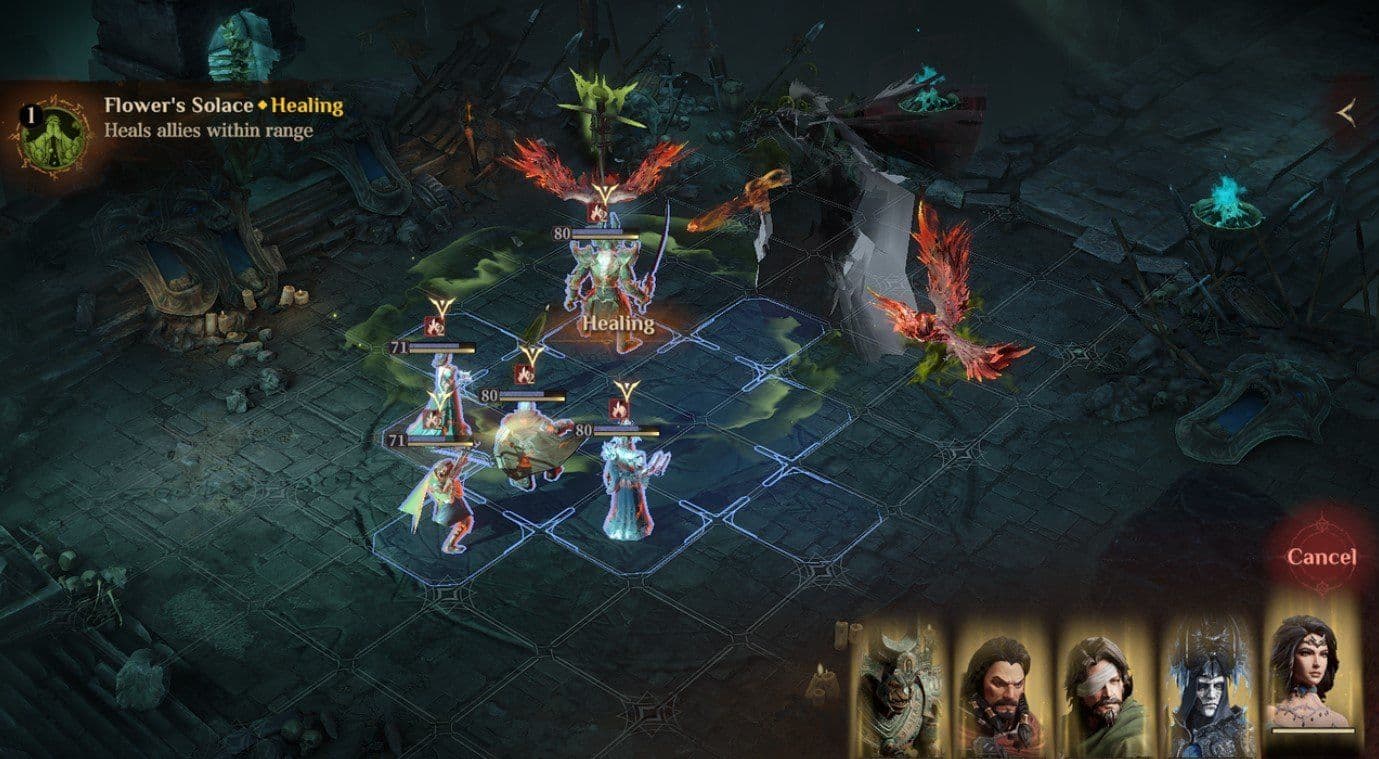
At first glance, combat in Dragonheir: Silent Gods might masquerade as a simplistic auto-battler: two opposing squads clash across a tiled grid, trading blows while colorful numbers flood the screen. Yet the moment you clear the introductory chapters and confront your first high-tier dungeon tyrant, that illusion rapidly shatters. The game transforms into an unforgiving spatial puzzle running in semi-real time, where an error of a single tile separates flawless execution from an immediate team wipe.
Engagements commence with the pre-battle deployment phase across a spatial chessboard. Placing your five heroes is not merely a formality; it establishes your frontline survival geometry. Enemy AI routines reliably acquire the nearest target within their detection cones, meaning the precise placement of your vanguard tanks (Defense) dictates the entire damage vector of the encounter.
The golden rule of positioning is deciphering enemy attack geometry. If a boss unleashes wide frontal cleaves, slotting a fragile melee damage dealer into the adjacent tile next to your guardian guarantees their demise within five seconds. Other elite threats unleash sweeping flame cones or circular floor hazards, requiring ranged marksmen and spellcasters to scatter across opposing quadrants. Conversely, if your dedicated support—such as the indispensable healer Heksandra—channels a localized dome shield or healing aura, your team must cluster tightly within the boundary, balancing protective buffs against the imminent danger of area-of-effect crowd control.
Every hero operates across a three-tiered skill hierarchy:
1. Passive Skill — functions continuously, establishing the character's functional baseline (e.g., permanent enemy defense reduction auras, party-wide elemental resistance, or retaliatory counter-attacks upon taking damage).
2. Battle Skill — activates automatically on rigid cooldown cycles (typically every 8 to 12 seconds), supplying regular DPS rotations, minor self-shields, or fleeting debuffs.
3. Ultimate Skill — the defining asset of the character's kit. Ultimate energy accumulates via basic attacks and incoming damage, with regeneration rates governed by Attack Speed and Skill Haste.
The ultimate mechanic marks the clear dividing line between casual progression and hardcore endgame mastery. While an automated combat toggle allows characters to expend ultimates the millisecond their energy gauges fill, relying on full auto during high-level content is outright suicidal.
Bosses in Dragonheir execute telegraphed wipe mechanics with clearly visible cast bars. When a colossal arachnid in the Grave of Venom rears back to coat the arena in lethal neurotoxin, survival demands split-second manual interruption. You must hold your knight's ultimate in reserve, unleashing a pinpoint stun precisely one second before the boss cast finishes to negate the wipe. If a tyrant is immune to crowd control, the player must manually drop a defensive bubble over the squad at the exact moment of impact. Targeting reticles are fully interactive: dragging ability icons allows you to manipulate angles, widen cones, and lead moving targets to engulf multiple threats at once.
This mechanical depth is layered atop the Elemental Affinity system. Six elements are locked into three allied pairings per season:
Fielding three or five heroes from the same allied pairing bestows substantial passive bonuses to maximum health, defense, and attack power (up to +20–25% to core attributes). Deploying an unstructured lineup devoid of affinity synergy sacrifices nearly a quarter of your potential combat throughput.
Specialized team archetypes build upon these elements:
The catch lies in the uncompromising mathematical gatekeeping of auxiliary stats. The game enforces a strict dice duel between Accuracy and Resistance. If your debuffer's accuracy rating falls beneath the boss's innate resistance threshold, every silence, defense-down, or buff-strip will register as a complete miss. Furthermore, the Enlightenment attribute dictates the scaling of all healing throughput and periodic damage ticks; building a healer with pure attack power instead of enlightenment yields an ineffective shell incapable of keeping tanks alive. In Dragonheir, there is no single master squad: the game demands a stable of highly specialized compositions engineered for specific encounters.
In an online genre where story is routinely treated as disposable window dressing—hastily bypassed via a ubiquitous "Skip" button—the narrative ambition of Dragonheir: Silent Gods arrives as a startling revelation. The writing team crafted a sweeping dark fantasy chronicle deeply indebted to pen-and-paper tabletop modules, evoking the grim political realism of George R.R. Martin and the monster-stalked frontiers of Andrzej Sapkowski.
The journey opens amidst an eerie twilight void. Your protagonist awakens upon a crumbling sacrificial altar, stripped of memories, origins, and identity. The sole breadcrumb is an ancient draconic relic humming against your palm and an echoing primordial resonance. It soon becomes evident that the protagonist is no ordinary itinerant mercenary, but the Child of Chaos—a cosmic nexus of raw creation and entropic energy possessing the latent power to heal the fractured realm or irrevocably consign it to draconic ruin.
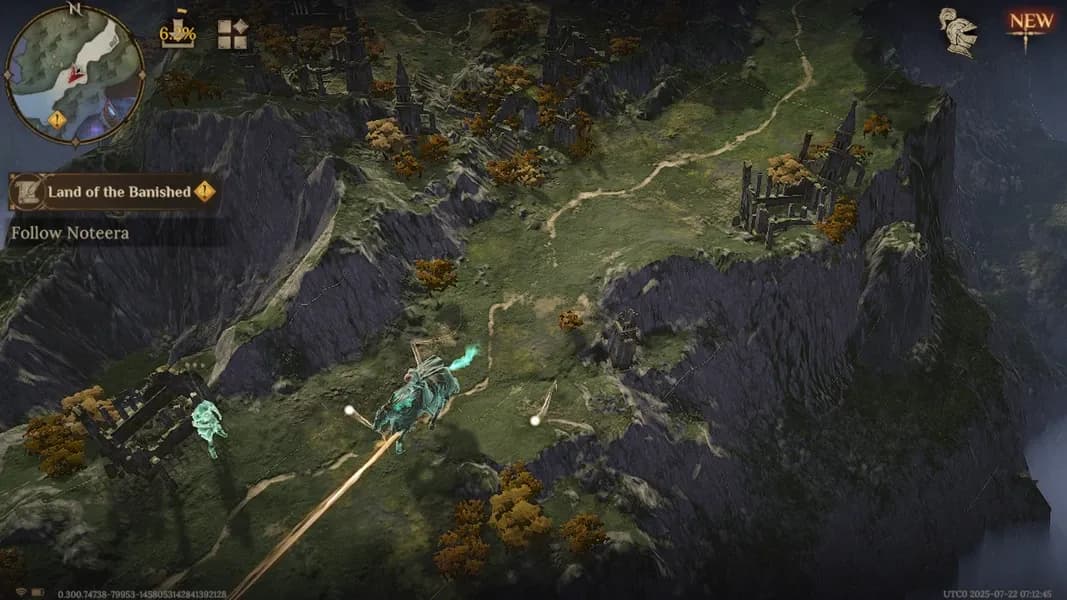
The continent of Adenthia, serving as the sprawling canvas of the opening season, eschews whimsical high-fantasy tropes in favor of grounded medieval grit. The continent is partitioned into stark, atmospheric biomes, each defined by distinct architectural styles, local superstitions, and indigenous perils:
The narrative's greatest triumph is its commitment to branching investigative quest design. Rather than drowning players in generic fetch quests, Dragonheir structures its major arcs around multi-layered mysteries. Arriving at a nobleman's fortified manor, players find themselves thrust into a classic parlor whodunit: interrogating duplicitous stewards, rolling Insight or Investigation checks to detect trace poisons in celebratory wine goblets, unlocking concealed passageways, and aligning mystical optical lenses to solve runic door puzzles.
The narrative consistently forces players to navigate morally ambiguous crosscurrents. Do you execute a frantic cultist who turned to blood rites solely to cure his plague-stricken kin? Do you turn an escaped conscript over to a ruthless magistrate for public execution, or forge military discharge papers through a risky Deception roll, alienating the local mercenary guild in the process? These choices hold tangible weight, determining access to black-market dealers, hidden caches, and the survival of regional settlements. Fully voiced cinematic dialogue across major milestones injects authentic theatrical gravitas into every confrontation.
Where does the narrative armor crack? In the pacing friction introduced by artificial level-gating. Progression across the main campaign is tethered to your overall Journey Level. At multiple dramatic zeniths, the narrative abruptly grinds to a halt with an unyielding mandate: "Reach Journey Level 25 to continue." If you have neglected your daily dungeon progression, the game forces you to step away from urgent murder investigations to grind experience dungeons for hours. Even with this live-service impediment, Dragonheir succeeds in delivering a genuine tabletop campaign atmosphere seldom seen in the live-service space.
In the overwhelming majority of hero-collector RPGs, your avatar is little more than a disembodied digital profile icon hovering quietly in the upper corner of the user interface. Dragonheir: Silent Gods resolutely abandons this convention, recapturing the tabletop role-playing tradition where every adventure begins with a meticulous character sheet and the deliberate allocation of foundational ability scores.
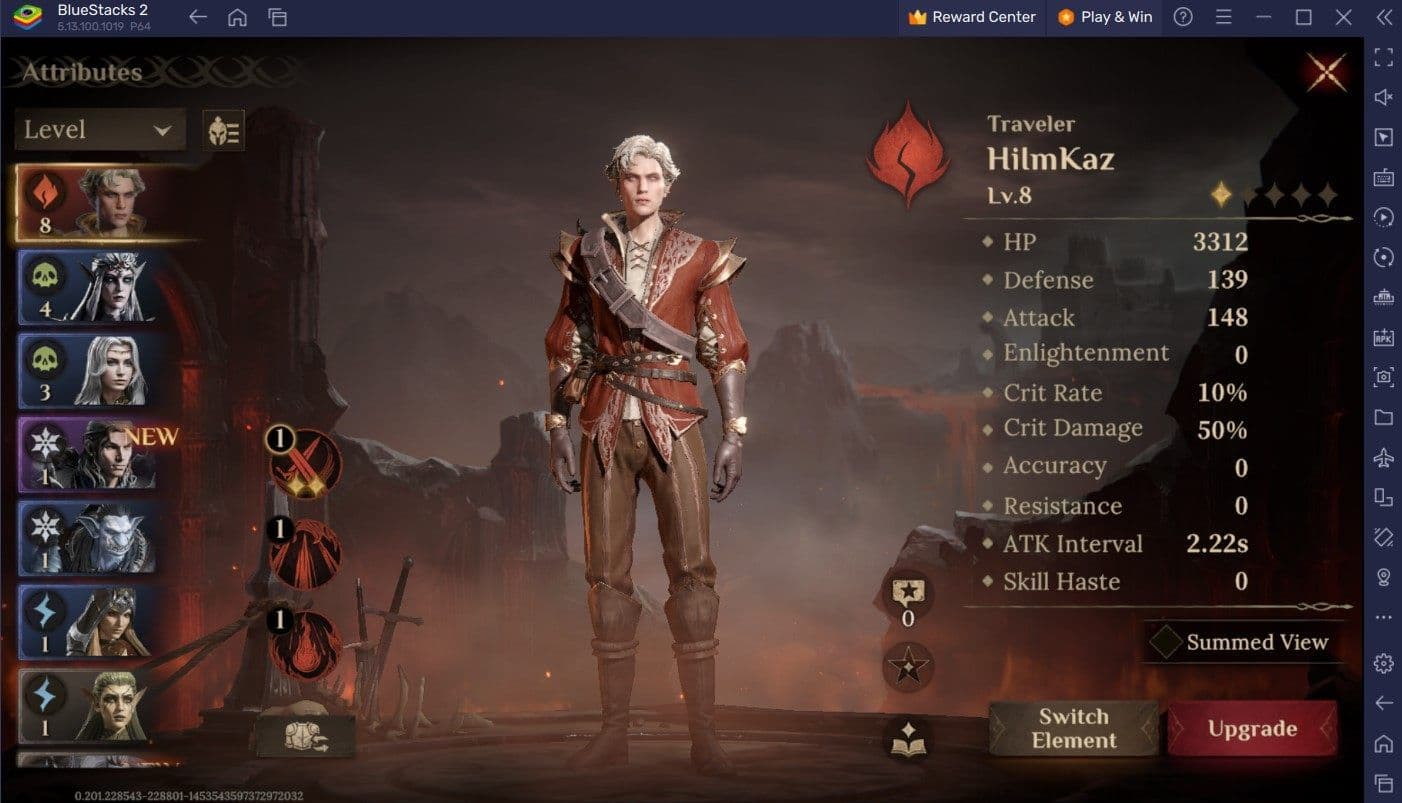
Character creation for the protagonist—the Traveler—is modeled directly after fifth-edition pen-and-paper rules. Players select their ancestry (Human, Elf, Dwarf, or Lizardfolk), customize their physical appearance, and pick an originating background that dictates starting attribute distributions: Strength, Dexterity, Constitution, Intelligence, Wisdom, and Charisma.
Every point invested into an attribute serves as a permanent mathematical modifier for your open-world D20 checks. Investing heavily into Charisma allows your Traveler to defuse bandit confrontations and negotiate trade concessions without ever drawing a weapon. Prioritizing Dexterity transforms the protagonist into a master cutpurse and lockpicker, emptying guarded manor vaults under the noses of patrol sentries. High Intelligence deciphers archaic runic monoliths and unlocks mystical arcanist puzzles, yielding generous caches of Wyrmarrow and rare artifacts.
In tactical engagements, the Traveler serves as an unparalleled elemental chameleon. Beginning the campaign as a frontline Fire bruiser delivering aggressive cone-cleaves, the protagonist subsequently unlocks Ice, Lightning, and additional disciplines across major storyline milestones. Players can freely swap the Traveler's active element and complete ability kit while resting at camp without expending precious resources. This transforms the protagonist into a permanent "joker in the deck," effortlessly plugging vacant roster slots to satisfy elemental resonance requirements without forcing players to gamble on gacha banners during early progression.
Yet surviving the perils of Adenthia requires assembling a broader warband, drawing from a roster exceeding two hundred distinct mercenaries categorized by rarity: Common, Rare (blue), Epic (purple), and Legendary (gold).
It is here that Dragonheir delivers its most welcome design subversion: the profound mechanical value of Rare (blue) heroes. In predatory competitors, blue units exist solely as expendable fodder to rank up elite gold units. In Dragonheir, several Rare and Epic champions possess such indispensable utility profiles that they remain staples all the way into competitive endgame leagues:
Naturally, top-tier Legendary heroes such as the famed drow ranger Drizzt Do'Urden, the Wild sorceress Flora, or the elemental shaman Erweg generate astronomical damage numbers. Yet even the most prestigious golden carry remains utterly helpless if their squad lacks a dedicated blue support capable of cleansing an enrage stun or sundering a boss's armor barrier.
Character progression spans four distinct tracks: baseline level elevation via experience potions, elemental Ascension using domain crystals, specialized talent tree branches, and skill upgrades via scrolls.
The trap in this system lies in the punishing scarcity of Skill Scrolls. Raising an ability's rank does not merely amplify damage coefficients; it fundamentally reduces ultimate cooldown intervals by vital seconds, dictating whether you can cycle an interrupt before an enemy wipes your squad. Epic and Legendary scrolls are rationed in minuscule quantities through demanding seasonal achievements. If an inexperienced player mistakenly squanders golden scrolls on an off-meta hero, their account can hit an unyielding progression wall for weeks. In Dragonheir, strategic resource allocation carries profound consequences.
While the campaign of Dragonheir: Silent Gods entertains players with dialogue branching, murder mysteries, and open-world puzzles, the true heartbeat of the endgame pulses inside instanced dungeons. It is within these subterranean vaults that team synergies face their ultimate audit, and the slightest flaw in gear optimization or skill timing results in immediate squad annihilation.
Daily life in Adenthia is governed by a strict energy economy known as Stamina / Bread. Energy regenerates at a measured cadence, and running high-tier dungeons extracts a hefty tariff (typically 12 to 24 bread per entry). This forces players to establish rigid tactical priorities from day one: do you invest today's finite energy reserve into experience draughts, farm elemental ascension crystals, or dump your entire daily allotment into hunting legendary armor sets?
The foundation of progression rests within the Goblin Lair. This is a high-velocity timed gauntlet where swarms of agile goblins flood the chamber from all angles. Slow, deliberate single-target assassins are useless here; conquering the lair demands specialized AoE artillery—such as the execute archer Sigrid or the Fire Traveler—capable of cycling devastating field-wide clears. Clearing the lair supplies the essential experience potions required to level your roster.
The true trial by fire, however, arrives across the three great equipment graves. The developers deliberately rejected universal gear solutions; each grave tyrant is built around a distinct mechanical puzzle requiring a specialized counter-composition:
Dotted across the map are the Elemental Domains (Flame, Frost, Tempest, Radiance, and Necrosis). These instances supply the ascension crystals required to uncap hero levels every twenty tiers. Ignoring the elemental triangle is fatal: venturing into the Domain of Frost with Lightning units invites instant freezes and devastating one-shot counters, mandating dynamic roster shifts.
For players reaching seasonal power peaks, the Pillar of Trial unlocks. This is a multi-floor gauntlet partitioned strictly by elemental schools. In the Flame and Poison pillar, the interface locks out all other disciplines, barring your frost and radiance stalwarts from entering. This mode ruthlessly exposes roster vulnerabilities: you cannot lean on a single over-leveled carry squad, forcing you to develop, ascend, and gear second- and third-string units. Conquering higher floors yields the most coveted rewards in the game: legendary skill scrolls and Heliolite summoning dice.
The catch lies in the ruthless double-layered substat RNG of gear farming. Even when a prized golden legendary armor piece drops on stage nine of a grave, its secondary substats may roll completely contrary to your archetype—rolling defense and resistance on an attack set, or omitting vital accuracy. Refining a competitive gear set for a single carry requires hundreds of dungeon runs. And knowing that this painstakingly farmed gear will dissolve into seasonal sand after three months transforms the gear treadmill into an exhilarating, yet psychologically taxing, race against the calendar.
In many contemporary online RPGs, crafting and gathering have degraded into hollow spreadsheet toggles: players click a "Craft All" button, wait for a progress bar to fill, and promptly forget the system exists. Dragonheir: Silent Gods takes a refreshingly tactile detour, returning to the tabletop roots of adventuring where a party's wilderness survival hinges directly on what bubbles in the communal stewpot and what glass phials clink inside the apothecary's satchel.
Exploring the isometric expanse of Adenthia is an inherently physical process. Guiding your party across misty highlands, rocky defiles, and riverbanks reveals a landscape rich in interactive nodes. Copper and iron veins break through crumbling hillsides, while patches of wild herbs—such as moonflower, frostroot, and fireweed—flourish in secluded groves. Gathering resources is completely free of automated shortcuts: maneuvering your avatar to a deposit triggers bespoke mining or foraging animations, depositing raw materials straight into your inventory.
The heartbeat of this frontier lifestyle is the Field Camp. Players can pitch camp across virtually any pacified clearing. Far from being a mere decorative backdrop of resting companions and flickering embers, the campsite serves as a functional mobile workshop uniting field cooking and alchemy:
The impact of alchemy on progression cannot be overstated. If your squad marches into the Grave of Venom at difficulty tier eight only to be melted by the broodmother's opening toxic spew, the root issue is rarely a lack of hero levels; it is a neglect of crafting. Downing a crafted Poison Resistance Potion prior to dungeon entry shaves an immense 50 to 70 points of incoming elemental damage, enabling undergeared tanks and supports to withstand lethal spike phases. During the early and middle weeks of a fresh season, alchemy acts as a vital equalizer, compensating for missing gear substats through deliberate preparation.
Municipal town forges complement this loop, allowing players to smelt gathered iron and cured pelts into solid baseline equipment. This shields newcomers from venturing into dangerous instances wearing tattered rags, establishing an accessible gear floor through self-reliance.
Where does the survival loop introduce friction? In fixed resource respawn timers and tedious daily harvesting routes. Rich mineral veins and rare flora operate on 24-hour server reset cycles. Stripping a mountain ridge of frostroot means waiting until tomorrow for replenishment, pushing competitive players to memorize daily gathering circuits that can feel like mandatory homework. Furthermore, food buffs expire after a set threshold of battle encounters: forget to refresh your meat stew before stepping through a boss fog, and your vanguard may collapse for want of that missing health buffer.
While the narrative campaign of Dragonheir: Silent Gods can be experienced in complete isolation, the game's live-service architecture asserts itself the moment solitary trials are exhausted. The project establishes an intricate communal web centered on alliance warfare, collaborative world boss raids, and asynchronous gladiator duels.
The foundation of cooperative play is the Alliance system. Pledging fealty to an active clan unlocks access to a collective guild technology tree. By contributing daily resource donations and completing clan bounties, members passively enhance squad-wide health, attack, and defense metrics across all game modes, while the alliance commissary stocks scarce summoning scrolls and rare crafting catalysts.
The ultimate benchmark of an alliance's mettle, however, is the Temporal Vortex. This is a massive cooperative raid encounter accessible to guildmates once per day. Players square off against a primordial cosmic entity possessing an infinite health gauge. The objective is not to slay the titan outright, but to inflict the highest cumulative damage score possible across allotted combat rounds before your squad is inevitably overwhelmed.
The Temporal Vortex is the premier proving ground for high-level theorycrafting. The entity cycles its elemental affinity and debuff mechanics on a weekly cadence. When the boss channels howling froststorms that suppress ultimate energy generation, squads must pivot toward Fire and Poison combinations built around the Wild discipline. When the encounter shifts toward Necrosis, players must retool for Radiance shielding and proactive cleansing.
Damage scores across all alliance members pool into a global server leaderboard. At the conclusion of each three-month season, an alliance's standing on the Temporal Vortex ladder dictates the lion's share of end-of-season dividends: premier guilds walk away with mountainloads of Pure Sand Core currency and exclusive artifact chests, securing an immense competitive head-start for the subsequent season.
Individual player competition converges upon the Grand Gladiator Arena. PvP operates in a classic asynchronous framework: players establish a five-hero defensive phalanx across the spatial grid, locking in their positioning. The defensive formation is piloted entirely by artificial intelligence, granting the attacking player the strategic advantage of inspecting the board and engineering a bespoke counter-lineup.
Tactical depth on the Arena board mirrors high-tier dungeon encounters:
The pitfalls of this competitive framework lie in rigid guild attendance mandates and the unyielding "whale ceiling" at the top of the ladder. In high-ranking alliances, casual play is strictly forbidden: missing a single daily Temporal Vortex attempt risks immediate expulsion, as every lost million points drags the guild down the rankings. Meanwhile, at the summit of the Grand Gladiator Arena, tactical brilliance often collides with an impenetrable wall of raw spend: when an opposing defense consists of fully maxed Legendary heroes with rank-five Inspiration dupes and refined golden artifacts, mathematical stat inflation easily overpowers tactical finesse.
In the realm of free-to-play tactical RPGs, the boundary separating fair intellectual contest from predatory financial extraction is notoriously porous. The architects behind Dragonheir: Silent Gods constructed a multi-tiered monetization structure that initially masquerades as a model of genre generosity, only to reveal familiar predatory hooks once players venture into high-stakes competition.
At the core of the economy lies the gacha summoning engine, thematically styled around sacred polyhedral dice:
The bad-luck protection system (Pity Mechanic) is refreshingly transparent: a guaranteed Legendary pull triggers on or before the 35th Heliolite roll on featured event banners. The primary in-game conduit for purchasing these dice is Wyrmarrow, with individual dice commanding roughly 350 units. Direct real-money outlays convert into Dragon Crystals, which are subsequently expended on resource bundles, cosmetics, and auxiliary stamina refreshes.
The monetization catalog adopts the classic live-service playbook:
1. Seasonal Battle Pass — universally regarded as the most cost-effective investment, awarding dozens of Heliolite dice, scarce skill scrolls, and exclusive character skins across a 50-tier progression track.
2. Monthly Sustenance Passes — supplying a steady daily drip-feed of Wyrmarrow alongside bonus daily stamina provisions.
3. Journey Level Milestone Bundles — one-time discount packages that unlock sequentially as your account level climbs.
What is the honest verdict for a strictly Free-to-Play (F2P) user? On this front, Dragonheir warrants genuine praise. The entire storyline spanning Seasons 1 and 2, the vast archipelago of world puzzles, and comfortable farming of mid-tier equipment graves (up to difficulty tiers 7 and 8) are 100% achievable without spending a dime.
Thanks to the exceptional tactical utility of Rare units (Heksandra, Sigrid, and the adaptable Traveler), a diligent player can clear almost all baseline content through clever positioning and elemental countering. During the opening weeks, the game showers accounts in summoning dice and currency, fostering the sensation that all summits are within reach.
The paywall rears its head the moment a player attempts to scale the competitive seasonal leaderboards.
The primary engine of wallet dominance is the Inspiration duplicate system. Pulling identical copies of an owned champion unlocks up to five inspiration tiers, each delivering massive percentage boosts to baseline statistics (+10–15% Attack, Health, and Critical Multipliers) while enhancing passive squad synergies. A five-star inspired Legendary in the hands of a heavy spender eclipses a baseline F2P Legendary by nearly 50% in raw mathematical throughput.
The secondary pressure point is acute FOMO surrounding limited-time collaboration banners. Events showcasing Dungeons & Dragons luminaries—such as Drizzt or Elminster—operate on strict expiration dates. If a player lacks a banked hoard of Heliolite dice and fails to hit the pity threshold before the event window closes, those iconic heroes vanish from the summon pool indefinitely. When paired with unlimited cash-shop stamina refreshes enabling spenders to grind top-tier graves around the clock, an unbreachable chasm opens between casual adventurers and the upper echelons of the Temporal Vortex ladder.
Engineering a cross-platform live-service RPG is fundamentally an exercise in diplomatic compromise: developers must navigate the vast gulf separating constrained mobile SOCs from high-performance desktop hardware. In the case of Dragonheir: Silent Gods, the engineering team at SGRA Studio achieved an exemplary technical adaptation of the Unity engine for the personal computer.
The native Windows client on Steam and its proprietary launcher delivers rock-solid frame pacing and thorough visual scalability. The game operates without a hitch at native 4K at an uncapped 120 frames per second on modest mainstream graphics hardware like a GeForce RTX 3060 or Radeon RX 6600. Support for ultrawide 21:9 displays is implemented with genuine spatial integrity: rather than simply stretching the 16:9 viewport, the isometric camera expands its field of view, revealing wandering monster patrols, mineral veins, and hidden puzzle chests long before they enter standard frames.
Storage optimization deserves particular commendation. While the fully patched client occupies a modest 18 gigabytes of disk space, installing the game onto a Solid-State Drive (SSD) is practically mandatory. Exploring the continent of Adenthia relies on aggressive background asset streaming for high-resolution textures and environmental clutter; running the client on a legacy mechanical hard drive introduces noticeable half-second hitches when crossing regional thresholds and protracts loading transitions into gear graves.
Control ergonomics on the desktop feel deliberate and intuitive:
A watershed moment in the game's operational history arrived with the sweeping Reborn initiative. Responding directly to player fatigue regarding the repetitive seasonal leveling grind, the developers implemented the Level Resonance altar. Players no longer need to exhaust their stamina budgets feeding experience potions to dozens of individual heroes; elevating five core squad anchors automatically pulls your entire secondary roster up to parity. Paired with flexible multi-branch hero talent trees and gear attribute transfer systems, the overhaul significantly mitigated repetitive chores, allowing tactical experimentation to take center stage.
Dragonheir: Silent Gods is a remarkably daring and accomplished hybrid that successfully bridges the gap between old-school isometric party-based cRPGs and the competitive rigor of a live-service seasonal league. It refuses to function as passive background entertainment, demanding instead an engineer's mindset toward roster optimization, a keen eye for board geometry, and a healthy respect for the fickle whims of the twenty-sided die.
If you cherish Forgotten Realms lore, relish tabletop strategy, and find intellectual joy in constantly solving fresh team-building puzzles within a shifting seasonal meta, the game offers hundreds of hours of rewarding tactical adventure without asking for a solitary cent to conquer its story. However, if the thought of watching your mastercrafted armor evaporate into seasonal dust fills you with dread, or if you demand direct non-target action combat from an over-the-shoulder perspective, the treacherous wilderness of Adenthia may prove an unforgiving home.