 F2P · Live
Lineage 2 Essence
Lineage 2 Essence is NCSoft's free-to-play take on the classic Korean MMORPG Lineage II, built around faster…
World of Titans MMORPG is a classic high-fantasy Theme Park MMORPG built on Unreal Engine by independent developer Archage Studios, drawing deep inspiration from mid-2000s World of Warcraft Classic. S...
Quick take: Forged from the ashes of the troubled indie project TitanReach after Archage Studios acquired its rights and spent four years rebuilding it on Unreal Engine, World of Titans MMORPG aims straight at the heart of World of Warcraft Classic nostalgia. A level 60 launch cap, a bitter two-faction war between The Honored and The Forsaken, and seven strict Holy Trinity classes form its foundation - upgraded with mid-combat weapon swapping and reactive enemy AI. Currently running Closed Pre-Alpha tests through the TITANGATE launcher on the starter island of Gal'Tal, the game promises an unlimited Free-to-Level-20 entry model on its road to a late 2028 worldwide release.
The very name World of Titans hits any genre veteran right between the eyes. It carries a deliberate double reference: first to the foundational era of classic World of Warcraft, and second to Project Titan - the legendary next-generation MMORPG that Blizzard cancelled before it ever saw the light of day. Subtlety is not on the menu here. Independent developer Archage Studios (entirely unrelated to the Korean sandbox ArcheAge, despite the similar spelling) makes zero effort to hide its blueprint. Rather than spinning up another gray-market private server with custom patches and waiting for cease-and-desist letters, the team set out to build an original mid-2000s Theme Park MMORPG from the ground up in Unreal Engine.
Getting to this point took a brutal detour. The project's lineage traces back to TitanReach by Square Root Studios - an early-decade indie MMO that failed its Kickstarter campaign, spiraled into funding crises, and nearly torched its remaining goodwill with a last-ditch pivot toward crypto tokens and NFTs. When Archage Studios purchased a portion of those rights and visual assets, veteran MMO journalists treated the announcement with understandable suspicion. A rebrand alone rarely fixes a broken foundation.
Four years of quiet, methodical reconstruction changed that equation. All legacy gameplay footage from 2022 was scrubbed from official channels, the rendering pipeline was migrated to DirectX 12, and studio leadership publicly ruled out both blockchain schemes and mobile ports in their official Discord. What exists today as World of Titans is a fundamentally rebuilt title with its own lore bible, reworked netcode, and an unapologetically traditional design philosophy.
Core Design Philosophy: recapture the living-world magic of mid-2000s MMORPGs, where raid gear is earned through coordinated group sweat, every class brings irreplaceable utility to a party, and the screen remains free of auto-play buttons or battle-pass pop-ups.
Four classic design pillars anchor the entire experience, reviving mechanics that modern live-service blockbusters largely abandoned in pursuit of solo convenience:
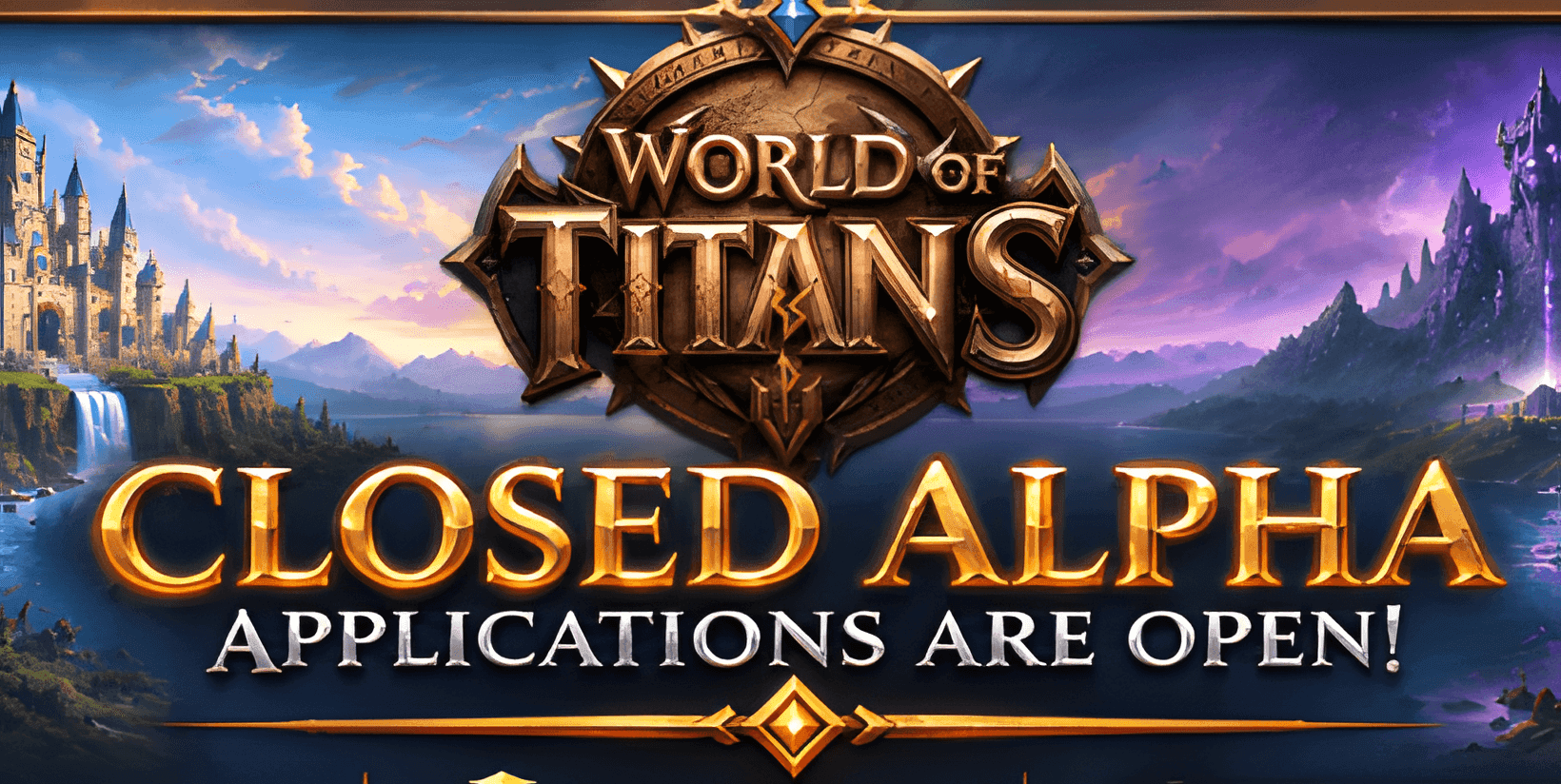
In late 2026, the project finally moved from internal studio builds to live external testing. Applications opened for the Closed Pre-Alpha via the proprietary TITANGATE launcher, putting real players onto three dedicated test realms - two in North America and one in Europe - backed by live Game Masters patrolling during peak hours. While current testing is strictly under NDA and confined to the starting island of Gal'Tal, the playable foundation already reveals how this indie team plans to stand apart from a mere nostalgia clone.
Copying a twenty-year-old combat loop verbatim only produces a museum exhibit. Archage Studios knows that trap well. While World of Titans retains the deliberate pacing of classic Tab-target combat, the developers have layered two major mechanical upgrades on top of the traditional hotkey bar: real-time weapon swapping and a reactive enemy artificial intelligence package.
The first signature hook is the New Weapon System. In most old-school theme-park MMOs, equipping a two-handed sword or a staff locks your character into a static rotation until your next trip to the bank. Combat rules hit harder here. Fighters can master Dual Wield blades, sword-and-board shields, and long-reach Polearms, swapping styles on the fly to match the flow of an encounter. When your Warrior engages a roadside patrol along the cliffs of Gal'Tal, you can open with wide polearm sweeps to control spacing, snap into a defensive shield posture with Guard when incoming damage spikes, and switch to dual blades to burn down a fleeing runner.
The second half of the combat identity rests on Advanced AI. Instead of programming brainless target dummies that stand motionless in fire while a tank spams a single threat button, the engineers trained the bestiary of Valendar to react dynamically to party tactics:
The Readable Encounters Principle: combat is engineered around instant visual clarity - players should recognize who they are fighting, what ability an enemy is telegraphing, and how their class responds without fighting a cluttered interface or blinding particle spam.
In their Combat in Focus development dispatches, the team breaks down how moment-to-moment movement defines an MMORPG's tactile feel. On the Gal'Tal pre-alpha realms, engineering passes heavily target strafing responsiveness, jump arcs, turn rates, stair traversal, and animation transitions. Any veteran of World of Warcraft Classic recognizes that specific muscle memory: holding a strafe key, jump-turning mid-stride to fire an instant ability, and landing without losing momentum. Capturing that crisp, zero-float movement loop is the primary benchmark for Archage Studios.
Interface layout follows the same minimalist discipline. Bold enemy silhouettes, high-contrast floating Nameplates, and clean Target Portraits keep critical threat data in your peripheral vision. Being a true Pre-Alpha build, some melee hit impacts and audio cues still feel raw - a point early testers frequently note in bug reports - but the underlying commitment to responsive, readable tab-target combat is unmistakable.
Most cash-strapped indie studios slap together a generic paragraph about "ancient evil" and immediately send players out to slaughter boars by the village gate. Archage Studios took the long road. The world of Valendar is backed by a multi-hundred-page internal lore tome titled World of Titans: The Prologue History, Final Rebuilt Edition - complete with specific page citations embedded directly into the official interactive map. According to the studio founder, the team modeled its world-building methodology on Tolkien's mythmaking, ensuring that every ruined watchtower and mountain pass carries an established historical weight before a quest giver ever speaks.
In the game's creation myth, the ancient Titan gods shattered primordial darkness and sealed The Void beneath the crust of the earth during a cataclysmic conflict remembered as The First Sundering. That victory did not hold. Centuries later, the scars of that ancient war began to bleed anew as the curse of Valakar stirred in the abyss. With mortal kingdoms fracturing and the light dimming, the heavens issued a call to the Titanborn - children of the stars and heirs of the divine flame who fall to earth not as omnipotent deities, but as mortal guardians.
Every player enters the game as one of these newly awakened Titanborn. Yet the inhabitants of Valendar do not greet your arrival with universal reverence: some hail you as a prophesied protector, while others view you as a living weapon, a dark omen, or a dangerous relic of an age that should have stayed buried. That ideological divide splits the civilizations of the mainland continent of Kalgarath into two warring superpowers:
Shades of Gray Over Cartoon Morality: official lore explicitly rejects pure good-versus-evil tropes - the rulers of The Honored frequently fail their own people under the weight of governance, while many among The Forsaken actively oppose Valakar even as they wield his dark methods to survive.
That moral friction gives the setting real teeth. Inside the human capital of Lyonhall, gleaming royal terraces look down upon overcrowded lower wards where King Aldar rules through harsh political compromises, leaving Elowen to turn public compassion into civic duty before resentment boils over. Meanwhile, The Forsaken are fractured between ambitious conquerors who believe the old order cannot be redeemed and tragic outcasts bound to the shadow by grief and broken oaths. Choosing your allegiance determines not only your banner in battle, but which harbor awaits your ship when you leave the starting island behind.
Every adventure in Valendar begins on the same sacred shoreline: the southern island of Gal'Tal, known in the chronicles as The First Shore. According to myth, this was the very first landmass the Titan gods raised above the waves of the Veilwater Sea. In gameplay terms, Gal'Tal is built not as a disposable tutorial corridor, but as a full-scale microcosm of the game carrying players all the way to level 20. Quiet fishing villages, family shrines, and trading docks blend naturally into high coastal cliffs, guarded roads, and weathered Titan rune stones.
In their The Making of Valendar design notes, the environment artists emphasize one overriding rule: silhouette-driven navigation. Zones are sculpted around bold color palettes and towering long-distance landmarks so travelers can orient themselves by the horizon rather than staring at a minimap arrow. Once a hero boards a vessel from Gal'Tal and crosses the southern sea, the mainland continent of Kalgarath opens up across more than thirty named regions, capitals, and waterways:
Rewarding Off-Road Curiosity: the world is explicitly populated to reward players who wander beyond quest markers - hidden cliffs and forgotten ruins house a dedicated Treasure Hunting system packed with secret chests, lore relics, and rare collectibles.
Crossing a continent of this scale requires travel systems that respect exploration without turning every quest into an hour-long jog. No free teleports exist at character creation. Instead, the New Teleportation System requires adventurers to physically discover regional hubs on foot before fast-travel routes unlock across the map. For overland speed and social prestige, players build out their stables through a progression-driven mount system featuring grounded beasts and prestigious Legendary Mounts that can be collected, upgraded, and paraded through capital plazas.
During its earliest TitanReach prototype years, the project flirted with a loose, classless skill-leveling structure where every adventurer could dabble in everything at the expense of distinct group identity. Following the studio reboot, Archage Studios scrapped that free-for-all completely. World of Titans restores the time-tested Holy Trinity architecture - expanded with a dedicated tactical support pillar - where tanks control positioning and threat, healers keep the party breathing, supports amplify group output, and damage dealers execute tight target focus.
Seven playable classes anchor the launch and pre-alpha roster, each engineered around a clear high-fantasy silhouette, solo rhythm, and group utility:
Two-Stage Build Depth: on the climb to level 60, every class progresses through a foundational talent tree before unlocking Advanced Skill Trees that reshape the character into specialized tank, healer, support, or damage configurations.
Those Advanced Skill Trees prevent the seven-class roster from collapsing into cookie-cutter clones. Cookie-cutter builds die fast here. Rather than forcing every Paladin or Druid into a single predetermined lane, the secondary trees let you tailor your build for main-tanking world bosses, buffing a five-player dungeon squad, or pressuring enemy healers in open-world skirmishes. Paired with the New Weapon System, every talent choice directly alters your active rotation.
Two additional progression layers round out character identity. First, the studio rolled out a Complete Character Customization Upgrade, expanding facial sculpting, body proportions, and racial options across all eight playable races of Valendar. Beyond cosmetics, adventurers can unlock pets, companions, and combat protectors through the Added Companions system - giving solo questers extra backup while hunting along the wilder ridges of Gal'Tal.
In far too many modern online RPGs, spotting another human being in your questing zone feels like a penalty: they tag your mobs, break escort scripts, and force you to camp respawn timers. Another player means an ally here. Cooperative play is wired directly into the foundational code of World of Titans. As detailed in the studio's Quest & Party Systems Update patch notes, engineers overhauled multiplayer questing across Gal'Tal so grouping removes friction instead of creating it. The backend synchronizes Phased Encounters, shares Objective Credit cleanly across party members, and governs escort NPC visibility so one adventurer's step in a storyline never bricks another player's progress.
Once players outgrow the opening quests of the starter island and push across the mainland of Kalgarath, PvE progression scales across four classic pillars:
Visual Gear Prestige: equipment in World of Titans is designed to tell a story at a glance - when a plate-clad Warrior rides through Lyonhall wearing a complete raid tier and a blade earned from a Legendary Quests chain, everyone in the plaza knows exactly what it took to earn it.
Naturally, during the current Pre-Alpha phase, these PvE layers sit at different stages of production. While multiplayer quest phasing, party combat, and the Gal'Tal storyline are actively being stress-tested on live TITANGATE realms right now, the broader mainland dungeon roster is scheduled to roll out in Alpha One (Q1 2027), and full raid tiers are slated for Beta One in early 2028. Crucially, the progression philosophy itself avoids predatory Eastern RNG upgrade loops - no shattering your hard-earned sword at a blacksmith, just boss mechanics, set piece hunting, and long-term questing.
Splitting the player base between The Honored and The Forsaken in World of Titans is far more than a cosmetic line on your character sheet - it acts as a permanent spark for PvP conflict. Safety ends at the harbor docks. Once your vessel leaves the neutral sanctuary of Gal'Tal for the mainland of Kalgarath, geography itself funnels rival allegiances toward collision. Look at the northern territories on the official chart: the orcish capital of Veyr Mourne and the outpost of Mournstead in the Plagued Tundra sit just across the mountain passes and Ironpine Forest from the dwarven gates of Ironhold in the Frostforge Highlands. Further south, the narrow land bridge of Central Reach and the trade roads converging at Goldmere Crossing form natural chokepoints where caravan routes and world-boss marches turn into ambush alleys.
Competitive and social play interlock across three distinct layers of warfare and community organization:
Zero-Friction Social Engineering: as highlighted in the November Development Notes, party and guild tools must feel dependable rather than fragile - forming a group should remove friction between strangers, never add another layer of UI frustration.
That philosophy explains why the engineering team is spending so much pre-alpha bandwidth polishing seemingly small social mechanics right now. Recent builds specifically tighten Party Leadership indicators, Invite & Kick Permissions, promotion rules, leave-party behavior during active encounters, player interaction distances, and automated Follow Functionality. In a classic-style MMORPG where parties actually travel across dangerous roads together to reach a dungeon entrance, getting those fundamentals right is what separates a memorable Friday night run from a logistical headache outside the capital gates.
Craftsmanship in World of Titans is woven directly into the cultural identity of the world rather than tacked on as a spreadsheet side activity. In The Prologue History, the subterranean dwarven capital of Ironhold inside the Frostforge Highlands is defined by its roaring smelting furnaces, heavy lift chains, carved waterways, and a society where an artisan's honor is measured by reliability, oaths, and settled debts. That same commercial lifeblood flows through the bustling middle wards of human Lyonhall and the overland crossroads of Goldmere Crossing, where caravans connect the western Plains of Elysium to the northern frontier.
To ensure artisans remain indispensable at every stage of progression, Archage Studios rebuilt its economic loop around a three-part New Profession System:
Built-In Anti-Bot Quarantine: to protect server markets from gold-farming scripts, accounts playing on the free Free-to-Level-20 tier are strictly locked out of direct player trading, guild banks, and the Auction House until they upgrade to the full adventure.
From an economic design standpoint, that quarantine hits the bullseye. Bots suffocate here. Anyone who has played a classic theme-park MMO knows how quickly disposable free accounts can strip-mine starter zones, flood global chat with RMT spam, and crash raw material prices within a week of launch. By isolating trial accounts on Gal'Tal from the commercial bloodstream of Kalgarath, Archage Studios preserves the value of legitimate gathering and crafting. According to The Road to Valendar roadmap, core professions come online in Alpha One (early 2027), the Auction House launches in Alpha Two (late 2027), and a dedicated macroeconomic tuning pass arrives in Beta Two during spring 2028.
Whenever an independent MMORPG carries turbulent historical baggage, players immediately scrutinize its business model for signs of cash-grab founder packs. World of Titans adopts a clean, transparent hybrid structure modeled on the classic World of Warcraft trial system. At worldwide launch, everyone can enter through the Free-to-Level-20 program: no credit card required, no countdown timer, and full access to all launch races, all seven classes, and the complete storyline of Gal'Tal up to level 20.
Sailing onward to the mainland of Kalgarath, pushing toward the level 60 cap, joining guilds, and unlocking economy features requires upgrading to the full adventure (game access and subscription entitlements governed by the official terms). On the web portal, the storefront - named The Vault - runs on a premium currency called ArchCoins across three categories: Game Access, currency bundles, and cosmetic Mounts. Notably, the store currently lists zero products for sale during Pre-Alpha. Having learned hard lessons from the TitanReach era, Archage Studios has refused to peddle aggressive pre-order packages before the game proves itself, while locking in a strict ban on Pay-to-Win items, crypto tokens, and NFTs.
Development Mantra: "Quality comes before the calendar" - the studio published a live seven-milestone interactive schedule titled The Road to Valendar, charting every testing phase from late 2026 through the end of 2028.
Inspecting The Road to Valendar gives prospective players a grounded timeline of what is playable today versus what lies ahead:
That timeline cuts both ways. The road ahead is long. On one hand, the transparency is refreshing: instead of promising an impossible six-month turnaround, an indie team is being honest about how long it actually takes to build a content-rich MMORPG. On the other hand, holding community momentum through late 2028 will test both player patience and the studio's financial runway.
Under the hood, World of Titans pairs lightweight stylized geometry with a modern Unreal Engine rendering pipeline built on DirectX 12. Even at this early stage, the studio has unified its live-service infrastructure: build deployment, account authentication, support tickets, and realm health telemetry all flow through the custom TITANGATE launcher. Current Pre-Alpha testing operates across three dedicated physical realms - two hosted in North America (NA) and one in Europe (EU) - giving testers on both sides of the Atlantic stable latency while exploring Gal'Tal.
Because the art direction prioritizes bold silhouettes and clean color palettes over bloated 4K photogrammetry textures, hardware requirements remain approachable by 2026 standards. Minimum specifications call for a 4-core 3.0 GHz processor (4th Gen Intel Core Haswell or AMD Ryzen Zen), 8 GB RAM, and a DirectX 12 GPU with 3 GB VRAM (GeForce GTX 900 series). For smooth frame pacing during large faction clashes across Kalgarath, the recommended tier steps up to a 6-core 3.5 GHz CPU (8th Gen Intel Coffee Lake or Ryzen Zen 2), 16 GB RAM, an 8 GB VRAM graphics card (GeForce RTX or AMD RDNA 2), and 20 GB of SSD storage.
Final Verdict:World of Titans MMORPG is a fragile yet earnest beacon for veterans exhausted by modern cash-shop grinders who want to recapture the cooperative spirit of mid-2000s online worlds.
Measured realism is the smartest approach right now. Rising from the wreckage of TitanReach was no small feat for Archage Studios, yet four years of steady engineering, a working TITANGATE ecosystem, the rich cartography of Valendar, and a clean monetization stance prove this is a genuine passion project rather than a quick flip. If you have the patience for rough early builds, want to test mid-combat weapon swapping along the shores of Gal'Tal, and enjoy filing bug reports alongside active GMs, applying for the Closed Pre-Alpha on the official website is well worth your time. Everyone else longing for an old-school Theme Park MMORPG should wishlist the game on Steam and watch closely as the team tackles its 2027 alpha milestones.